'It's great bringing unique culture to the outside world'
Updated: 2011-09-16 07:49
By Lee Hannon (China Daily)
|
|||||||||||


For Gui Bin, winning a gold medal for his home province, Guizhou, at the National Ethnic Games would be the ultimate lifetime achievement.
Even more so, because his province is playing host to the ninth National Ethnic Games.
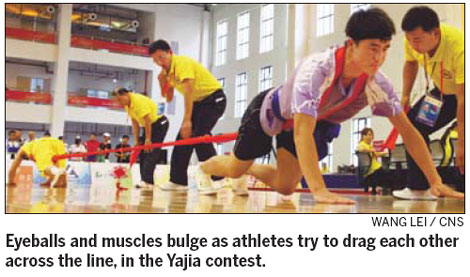
The determination is etched on the 23-year-old Gui's face as he grapples with a ring with a long piece of silk and places it around his neck before threading it between his legs.
Welcome to world of the "elephant-tug-of-war", or Yajia, in Chinese, one of the more colorful events in the multi-ethnic sports special.
The sport was added to the games in 1999 and is popular among Tibetan ethnic group. It somewhat resembles the more common rope-pulling version played around the world.
It usually takes place on a hard, flat surface at a farm or a park and is just a part of daily life. Nonetheless, Gui has been training hard for it. First he assumes an uncomfortable starting position, and the silk rope is stretched across the traditional tug-of-war line, two meters wide by nine meters long before it is looped through the opponent's legs, then up across his stomach and around his neck.
Gui faces away from his opponent, an equally determined-looking man from Hubei province, and the two assume the back-to-back starting position crouched so low that it looks as if they're going to do some push-ups.
Using the tips of their toes and hands for balance, and the upper body and neck to pull, they attempt to drag each other across a middle point in a bizarre mix of force, motion, and show that might leave a chiropractor weeping.
Gui's gaze is fixed straight ahead to a point just a few inches above the ground, as he lets out a mighty roar that seems to transcend all languages. His look is that of one of those body builders about to pull a double-decker bus.
With the second roar, the spectators are whipped into a frenzy, as Gui slowly inches forward. The bodies shake, veins pop out, and something makes a crunching sound but I can't tell what.
Victory comes fairly swiftly in this gladiatorial battle and the winning roar follows.
When asked how it felt, Gui beams, "I'm the best in my group. I've been training very hard for this and when I hear my teammate shouting for me it's a very special moment."
Gui from the Manchu ethnic group and is a management student at a local university. He took up the elephant-tug-of-war two years ago and is quite proud of being able to take part in the games.
"It is great to bring the unique culture to the outside world."
Across the way from the Guizhou stadium where Gui claimed his prize, spectators at another event are being treated to a dazzling display of ethnic diversity.
The whole thing is like a melting pot where old meets new, traditional song and dance being applied to a modern-day soap opera.
The Yao ethnic people are dressed in green and red, singing about building a new home. Another group begins a melody about a chicken fight, followed by a tale of two members of the nobility locked in a wrestling match.
The games were first held in 1953 and have evolved a great deal over the years. They now take place every four years as a showcase of traditional culture and prowess of ethnic groups. And it's clear from the shouts of the spectators that the sense of unity amongst the ethnic groups is alive and well - and competing.
(China Daily 09/16/2011 page22)