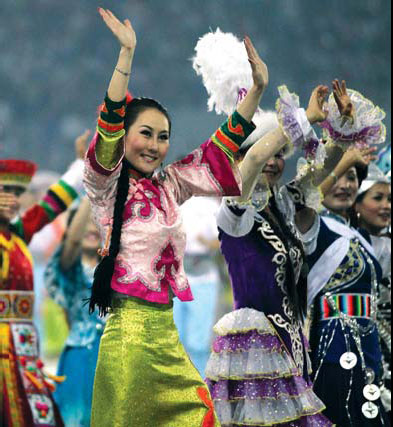
Protecting the cultures of Guizhou's ethnic groups
Updated: 2011-09-14 08:02
By Xu Lin (China Daily)
|
|||||||||||


|
Participants in the Games now underway in Guizhou come from diverse backgrounds. The province has 48 ethnic groups. Wang Jing / China Daily |
After two years of research by experts, Southwest China's Guizhou province has defined 17 items that represent cultures and traditions for ethnic groups that have lived in the region for generations.
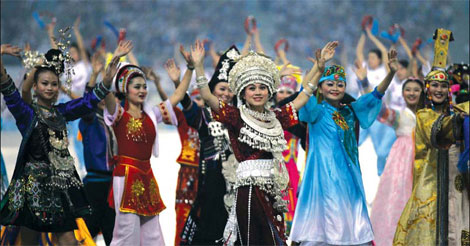
The items include traditional dances, festivals, clothing and headwear.
Guizhou actually has 48 ethnic groups that comprise 38.9 percent of the province's population.
"The selection is to promote and preserve the cultures of Guizhou's ethnic groups. We will apply for patents on 17 cultural symbols for the better development of the local ethnic culture industry, " said Wu Jun, director of the Guizhou Ethnic Affairs Commission.
The provincial government had invested 919.89 million yuan ($144 million) in "cultural infrastructure" by the end of 2010 so that most ethnic peoples now have access to books and radio in their native languages.
At present, 1,349 schools and universities provide bilingual education to 15,150 students in Chinese and other languages such as Miao, Yi and Yao .
According to a policy to preserve ethnic settlements, 20 ancient towns are now protected, including Xijiang, one of the largest Miao towns in China.
The Guizhou Ethnic Affairs Commission and Department of Culture are also working to preserve 500 characteristic ethnic villages along with ancient books and festivals while building museums.
Among the traditions names, two are widely known and popular with tourists: Yao herbal batch and Qiang New Year.
Yao herbal bath
The Yao people in the deep mountains have long enjoyed a form of herbal spa.
Old or young, male or female - all take a hot herbal bath in a wooden bathing bucket every day, which they believe keeps them healthy, eliminates fatigue and improves a woman's looks.
After finishing a day's labor, the first thing they do is boil herbs in a big pot and prepare for the bath.
Guests are the first to have a bath, followed by oldest male and the oldest female. Even newborn babies are included.
Qiang New Year
On the first day of the 10th lunar month - or November - usually the Qiang people stop farming and stay at home for three to five days and make flour dough in the shape of ox, sheep and chicken to offer as sacrifice to their ancestors and gods.
Wear newly crafted traditional clothes, they also make traditional foods, drink homemade wine in bamboo tubes, sing to urge others to drink, and play the traditional Qiang flute to celebrate the harvest.
In the night, they dance around a bonfire and young men dress up as cattle and sheep for mock fights.
|
Athletes in colorful costumes at the opening ceremony of the ninth National Traditional Ethnic Sports Games in Guizhou. Wang Jing / China Daily |