Harbin looks to innovate
Updated: 2011-06-03 10:47
By Lu Chang and Tian Xuefei(China Daily)
|
|||||||||||


|
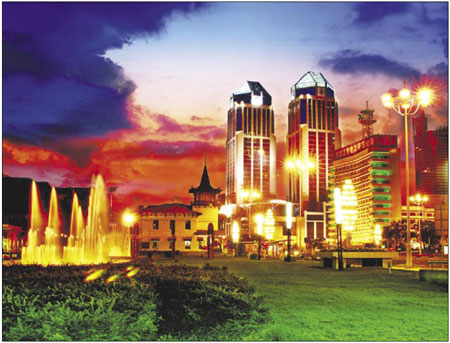
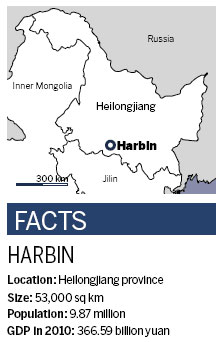
Harbin, capital of Heilongjiang province and one of China's old industrial bases, is transforming itself into a modern high-tech and manufacturing hub. Zhao Tianhua / for China Daily |
|
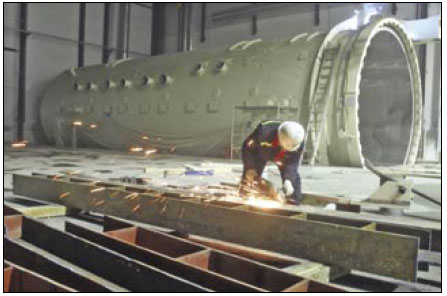
A worker welds equipment at the Harbin Hafei Airbus Composite Manufacturing Center. Provided to China Daily |
BEIJING - Crowds cheered when the group of eight contestants appeared on stage, under neon lights and dancing to music as part of the China's Got Talent show. It was just like any popular TV talent program, with one major difference - these were 30-cm tall robot dancers equipped with computers, sensors and batteries.
The robots could do more than dance. They mimicked other human movements like picking up trash, serving dishes and performing gymnastics.
The team behind the performance is from the robotic research lab in the Harbin Institute of Technology, in the capital city of Northeast China's Heilongjiang province.
They are part of Harbin's major economic transformation from an old industrial base to a modern, high-technology and manufacturing hub.
The city's economy has relied mostly on heavy industry, with traditional strengths in mining and equipment manufacturing.
But with the country implementing strategies to rejuvenate old industrial bases in the three northeastern provinces of Heilongjiang, Jilin and Liaoning, Harbin authorities are pushing for a major change - by making local companies innovators of modern technology.
The goal is to move away from mere equipment manufacturing to high-tech industrialization.
"The local companies, especially in the aircraft manufacturing sector, are climbing up the value chain," Harbin mayor Lin Duo said.
"We will continue to provide more support in science and technology as the major driving force in the local economy and create a fair competition environment for these companies."
Harbin Aircraft Industry (Group) Co Ltd (Hafei), a subsidiary of Aviation Industry Corporation of China (AVIC), is already making technological breakthroughs by cooperating with foreign companies that help put Harbin on the world map.
Hafei, a leading aerospace manufacturer in China, set up a manufacturing center with plane-making giant Airbus to produce composite material components for the A350 XWB.
"The inauguration of the manufacturing center demonstrates that we are well prepared for the production of the A350 XWB components. It's our pleasure and honor to be involved in the production of the world's most advanced aircraft and to become an integrated part of the global supply chain of Airbus," said Li Fangyong, vice-president of the AVIC.
The 33,800-square-meter state-of-the-art facilities are the first of what will be an 80,000-sq-m manufacturing compound, comprising production, technical support, office areas and other services. It is also an exclusive supplier for A350 rudders, elevators and maintenance doors.
Production of these parts will start in the first half of 2011 after the initial industrialization phase is completed in Europe.
The establishment of the joint venture is viewed as a result of Airbus' commitment to manufacture 5 percent of the A350 airframe in China under an agreement reached in 2007 with the Chinese government and a confirmation of Harbin's growing technology and distinct advantages in the aviation sector.
"Hafei has a long history in aviation manufacturing and it has vast composites application expertise for the development of commercial airplanes and helicopters," said Jose A. Veroz, general manager of the joint venture, the Harbin Hafei Airbus Composite Manufacturing Center.
"Besides, there are many technological universities and research institutes such as Harbin's Institute of Technology, which will supply us with many smart and experienced workers and engineers."
Veroz said the delivery of the first parts proves the capabilities of the manufacturing center in producing composite components.
With the A350 ramping up work, the company will need 600 employees in the manufacturing center by 2016.
The A350, Airbus' answer to the runaway success of US rival Boeing's B787, has received 860 orders for long-range, twin-aisle planes due to enter service in 2013.
China signed a letter of intent in 2006 to buy 20 A350s and Airbus had received 505 orders by the end of March.
Airbus is not the only foreign aviation manufacturer to cooperate with Hafei. As Harbin steps up efforts to become a major player in the sector, other global leading trunk line aviation manufacturers such as Boeing, Embraer, Brazil's airplane conglomerate, and a number of helicopter producers are scrambling to take advantage of the potential growth in the Chinese market.
Wang Xia, deputy president of the General Aviation College under the Civil Aviation University of China, said the construction of the joint venture is significant for expanding the strength of the aircraft manufacturing industry in Harbin, boosting the technical advantages in research and development of the aviation of Hafei and China, and stimulating the country's aviation industry to integrate into the world aviation industrial chain.
"The development of the whole industry will be accelerated by cooperating with foreign companies and introducing advanced technologies to provide industrial and management know-how and develop China's own products," Wang said.
"More importantly, it will help Harbin attract investment from other aviation-related companies for long-term impact on the future development of Harbin as an economic center of Northeast China."
Apart from the aircraft industry, the city has to date implemented key science and technology projects that aim to strengthen its innovation capacity of a wide range of industries.
The Science and Technology Department of Heilongjiang earmarked 20 million yuan ($3.1 million) in 2009 to set up a special fund to support small- and medium-sized companies in new product research and development.
In 2008 the province initiated an incentive package including advantageous tax allowances and dispensations over land use.
The incentives, coupled with central government support, have already generated high-tech industry strong growth this year.
In the first quarter of 2011, Harbin's high-tech industrial output value reached 56.3 billion yuan, increasing 27 percent from a year ago and accounting for a big chunk of the city's total GDP.
Growth of the software outsourcing sector was even more dramatic - with its combined sales revenues growing 54 percent compared to the previous year.
High technologies are now widely used in sectors like energy, modern equipment manufacturing, aviation, pharmaceuticals, food processing and new materials.
"High-tech is playing an increasingly important role in revitalizing Heilongjiang's traditional industries and fostering emerging industries," said Ji Bingxuan, Party chief of the province.
"Though we are already beginning to see the benefits, we are going to continue to give more support to stimulate growth across these sectors, since we still have a long way to go."
China Daily