News
Qianmen renovation: Gateway to prosperity
By Xu Xiao (China Daily)
Updated: 2011-05-12 08:01
 |
Large Medium Small |
|
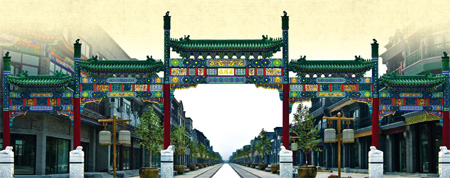
Restored Qianmen Street along the former royal pathway during the Ming and Qing dynasties. Photos Provided to China Daily |
|
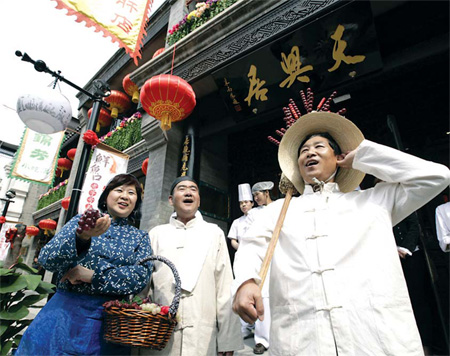
Peddling goods by chanting is a unique skill used by street vendors. |
Historic neighborhood in Beijing finds new life after a 13 billion yuan facelift
Visitors to Beijing are likely to tour the Forbidden City, Tiananmen Square, the Summer Palace and city gates formerly connected by tall, fortified walls.
But for those who want to discover the past and current lifestyle of locals, the Qianmen area is the place to go.
Qianmen Street and its neighborhood have been witness to Beijing's historic transformations over two dynasties and serve as a showcase of the city's folk customs, commerce and culture.
At the south end of the old city and neighboring famed Tiananmen Square, the Forbidden City and Temple of Heaven, Qianmen Street was born along with Beijing when it became the Ming Dynasty (1368-1644) capital more than 600 years ago.
Six centuries
Over those six centuries, the city underwent tremendous changes - the fall of dynasties and demolition of the city's walls - but life in Qianmen continued, even in the hardest times, creating historical and cultural legacies that survive today.
But in the past few decades local residents and authorities have faced new problems - endangered ancient buildings and relics, outdated facilities that fail to meet modern needs, deteriorating living conditions and a commercial sector selling faked and poor-quality goods.
Start in 2005
As Beijing continued to prosper and modernize, the district government began renovation of the Qianmen area in 2005.
Four years and more than 13 billion yuan later, builders had struck a balance between modernization and protection while improving the quality of life for residents.
The renovation work called for principals named the "four 100 percent": To inherit and promote traditional Chinese culture with 100 percent devotion, to save 100 percent of the relics and valuable buildings, to protect the intact outlook of the Qianmen area with 100 percent effort and to save 100 percent of the intangible cultural heritage.
Eventually, a shining new version of Qianmen Street appeared.
About 76 percent of the buildings along the street were repaired while maintaining their original look. The rest were rebuilt.
Workers also repaired and restored the symbols of Qianmen - the decorated archway of Zhengyang Gate, the 816-meter-long royal pathway of the Ming and Qing (1644-1911) dynasties and the trolley bus that disappeared for 42 years.
The area's opera house and guild hall - both city-level relics - were restored. Several temples, public bathrooms and other traditional structures were saved.
As well, the hutongs and siheyuans - alleyways and courtyards - home to longtime Beijing residents were repaired and protected to preserve the traditional look of the city while improving living standards of residents.
The intensive work not only retained most of the historic look, but also greatly modernized the urban infrastructure.
Underground pipes to carry electricity cables, water, gas and heat were installed under the royal pathway, breaking through the bottleneck that constrained improvements in the area for decades.
| 分享按鈕 |