News
Helping Jiangsu prosper by relying on traditional strengths
By Chai Hua (China Daily)
Updated: 2011-03-05 07:37
 |
Large Medium Small |
|
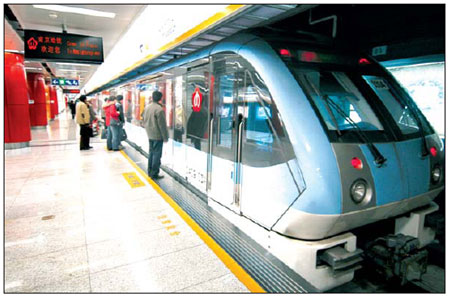
In the provincial capital, Nanjing, the subway system has taken the lead in Jiangsu, with 85 km of track in all. |
|
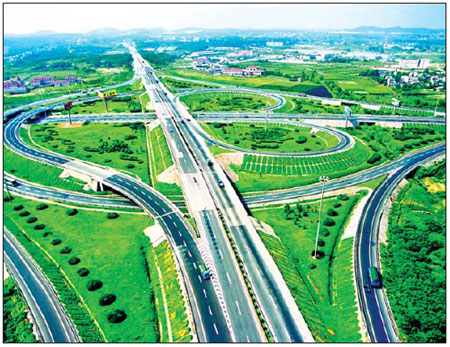
One of Jiangsu's modern expressways. Under the 11th Five-Year Plan (2006-2010), the province made transportation more convenient, with a total of 150,000 km of highways, compared to 83,000 km in 2005. |
Meanwhile, it is expecting its GDP to grow 10 percent in 2011, with 2.2 percent of that growth going to scientific research.
Foreign trade is expected to grow by more than 8 percent, while its utilized foreign investment, having been on top in China over the past five years, is expected to stay there.
Per capita disposable income among urbanites and the net per capita income of rural people are expected to be up about 10 percent by the end of 2011.
Li Xueyong, Jiangsu's governor, said in his work report at the province's fourth plenary session of the 11th People's Congress that, under the 12th Five-Year Plan (2011-2015), his province will focus on scientific development, building a better Jiangsu, and developing its economy better.
Jiangsu, in fact, has always been an economic powerhouse, so the central government has fairly high expectations for it.
President Hu Jintao has asked it to take the lead in improving Chinese society overall and in modernizing China. This is an indication of the province's record as an outstanding performer.
Its per capita GDP, above $7,700, is better than the national average.
Key year
This year marks the beginning of the 12th Five-Year Plan and it holds a special place in relation to whatever is accomplished in the future.
"In general, we have many strong points," Governor Li commented, suggesting that the domestic and international situation is conducive to Jiangsu's further development in a globalized economy.
The economic integration of the Yangtze River Delta region and the Jiangsu Inshore Regional Development strategy mean ample opportunities and a new impetus for Jiangsu's development.
That does not mean, however, that provincial development is without its complications.
There are pressures to increase exports and new demands for energy saving and emissions reductions.
And, improving the lives of its people and ensuring their well being are still challenges for the province, so, economic development becomes all the more urgent, Li said.
"First, we need to develop our confidence and make good use of our opportunities; and at the same time remain level-headed, aware of the potential dangers, and prepared to face challenges."
Over the next five years, Jiangsu will focus on structural adjustments in its economy, scientific and technological innovations, and environment protection, Li added.
Emerging industries have become a new growth area and the province has plans for new energy, new materials, pharmaceuticals, and software development.
In addition, service industries are expected to account for 48 percent of the province's economy by 2015, and high-tech industries for 40 percent.
Service industries have become a major part of its new economic structure, based on modern agriculture, with support from modern manufacturing techniques and new technology.
Last year, the province's patent filings were in first place in China. And, with the scientific developments of the past five years, it is expected to maintain its lead in scientific and technologic innovations, by putting 2.5 percent of its GDP into research and development in the near future.
Jiangsu wants to be an innovator, and has some big dreams for economic development. But that does not mean that it is not paying attention to environmental protection. Among all of China's provinces, it ranked third overall in environmental quality, in 2010.
Its forest coverage goal for 2015 is 22 percent.
(China Daily 03/05/2011 page11)
| 分享按鈕 |