News
Geothermal and hydro development fuel growth
(China Daily)
Updated: 2010-05-03 07:13
 |
Large Medium Small |
|
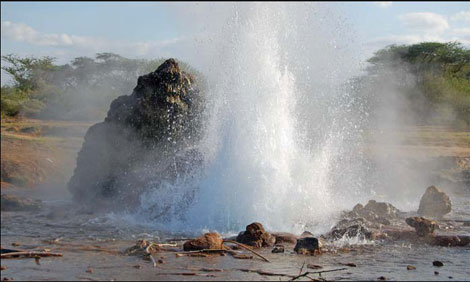
Lake Bogoria Geysers. |
Capital and expertise from China aid clean fuel advance
Kenya is endowed with significant amounts of renewable energy resources, such as wind, solar, geothermal, small hydro and biomass. However, few renewable energy resources in the country have been fully assessed, mapped and appraised for their technical and economic viability.
If harnessed these resources could play a significant role in the country's energy supply mix, so the government is keen to get up to speed in the coming years.
As the most widely used form of energy in Kenya, biomass energy resources are derived from forest formations such as closed forests, woodlands, bush lands, farmlands, plantations and agricultural industrial residues. These resources include wood-fuels and agricultural residues.
Although biomass fuels are the most important sources of primary energy in Kenya, with wood fuel consumption accounting for over 68 percent of the total primary energy consumption, the development of these resources cuts across various sectors and requires a multisectoral approach.
With electricity demand expected to reach 15,000 mW by 2030, time is of the essence, so the government has identified Kenya's untapped geothermal potential (currently estimated at between 7,000 and 10,000) as the most suitable indigenous source of electricity generation. It is embarking on an ambitious program to realize 4,000-5,000 mW of power by 2030.
To accelerate this, the government formed the Geothermal Development Company (GDC) to undertake a comprehensive geothermal resources assessment. GDC, which is charged with exploration, drilling, assessment and development of geothermal resources, will sell steam to Kenya Electricity Generating Company (KENGEN) and interested private investors to develop power plants and the generation of electricity.
Endowed with vast geothermal resources, the Rift Valley province has an estimated potential of between 7,000 and 10,000 mW. Out of this, only 202 mW has so far been developed.
Appraisal drilling is currently in progress in the Olkaria geothermal field for the development of 280 mW electric power plants. Twenty-five wells with an output of over 170 have already been drilled. At least 40 wells will be required for the power plants to reach their full capacity at a cost of $231 million.
The People's Republic of China recently extended a loan agreement of $90 million for the drilling of 26 wells attached to this project, which have the potential of producing an additional 140 mW.
"Using local resources and the help of development partners, such as the Great Wall Drilling Company, we have embarked on an ambitious drilling program", Energy Minister Kiraitu Murungi said.
"We hope to be able to generate at least the minimum 4,000 mW from geothermal resources. It is a major investment and we are appealing to other investors to join hands with us."
Opportunities for investment exist in various geothermal plants, which will produce between 50 mW and 140 mW in different sites around the Rift Valley within the next five years. Over the next eight years, the country plans to install additional geothermal capacity in excess of 720 mW, with GDC carrying out detailed surface exploration is Silali, Korosi, Barrier and Emuruangogolak. It will drill 566 wells, with a total amount of steam generation of 2,400 mW.
Minister Murungi, who oversees the GDC, said: "Total capital requirement for the project will be $2,567 million. Capital costs will be met from a government budget of $448 million, GDC net revenue from the sale of steam will be $520 million while support from development partners will be to the tune of $599 million."
Although hydropower plants have not been considered economical in the past, recent oil price increases now make them attractive for investment. The government has earmarked significant sites for small hydros, including stand-alone systems suitable to rural energy demand patterns.
The current known potential for mini and micro hydro is estimated to be 3,000 mW. Feasibility studies have been conducted and the Ministry of Energy has identified over 300 sites with a total potential of 600 mW. Private investors are being encouraged to aggregate several sites for joint ventures.
(China Daily 05/03/2010 page19)