Economy and Business
Shenzhen govt learns from big company playbook
By Wang Xin (China Daily)
Updated: 2010-02-10 07:39
 |
Large Medium Small |
Different from many of his peers who head up local intellectual property (IP) administrations, Xu Youjun works with an apparently unrelated organization, the Shenzhen Market Supervision Bureau. He is the deputy director of the city government department.
The difference in titles reflects the city's unique position in the national IP system, Xu said.
Three local government departments - press, IP, and industry and commerce - usually handle copyrights, patents and trademark administration separately, but the three administrative powers are all one unit in Shenzhen.
"Integrated administration, quite common in other countries, has proved to be efficient in practice," Xu said.
Due to the close relationship in IP between patents, trademarks and copyrights, more than one aspect is usually involved when an infringement case is filed.
Because the supervision bureau provides one-stop services, costs for applications and defending rights can be reduced substantially, Xu said.
The streamlined procedures have helped bring a boom in the local software industry.
Shenzhen-based software copyrights registered in 2009 surged to 5,543, a rise of nearly 125 percent over the previous year. The sector now generates more than 280 billion yuan in annual revenues.
The city's total patent applications maintained robust annual average growth of 24.13 percent from 2005 to 2009. Annual average growth in filings for invention patents over the same period was 37.8 percent.
The private sector, a dynamic force in the local economy, generated by far most of the applications, led by homegrown telecommunication giants Huawei and ZTE Corp.
Top 10 local companies accounted for around 80 percent of the city's total invention patent applications.
"Different from some regions - where local governments push enterprises to increase technological innovation - companies themselves are highly motivated to invest in research and development in Shenzhen," Xu said.
Ninety percent of the city's total research and development staff, investment and patents are in the private sector, he added.
"Profitability is the key to increased IP awareness. When companies come to realize IP brings them profits, they cannot value it more." He cited Netac, a Shenzhen-based maker of flash USB memory, as an example. Its annual revenues from patent licensing surpass its direct sales income.
"We don't have to worry about the commercialization of patented technologies. The patent holders are eager to commercialize their patents and make profits."
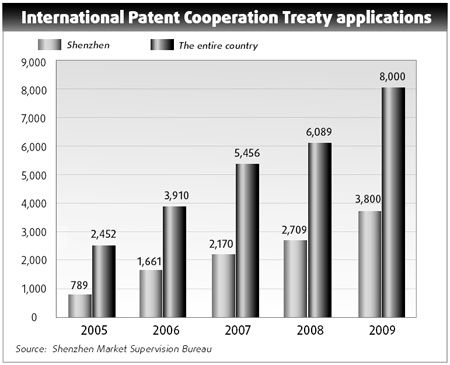
As they now eye overseas markets, Shenzhen-based companies filed 3,800 international Patent Cooperation Treaty (PCT) applications in 2009, nearly 45 percent of the country's total.
Huawei and ZTE Corp contributed the lion's share, more than 90 percent of the city's total.
Big companies at the forefront of market competition know market needs, Xu said, so the city has used their proposals to formulate policies and regulations to augment healthy growth of the entire industries.
From headline-grabbing battles between US-based Cisco and Shenzhen's Huawei to BYD's tussle with Japanese rivals Sony and Sanyo over batteries, the city government borrowed from their experience in maintaining IP rights abroad to design handbooks on proper response to overseas lawsuits.
Due to lack of experience, some Chinese companies fail to properly respond to complaints from abroad, though claimed infringements are sometimes untrue, Xu said.
The handbook includes a summary of possible defenses, risk appraisal and even references for intermediary resources to help less-experienced companies deal with the overseas complaints.
The government has also released guidelines on patent licensing, participation in exhibitions and development of small and mid-sized companies.
"We vow to build Shenzhen into an IP protection stronghold with a distinguished and friendly climate," Xu said. "The enhanced legal environment helps to ensure investors' faith and bring more capital to hi-tech sectors."