Zhengzhou
Ancient grandeur, birth of a culture
By Cui Wei (China Daily)
Updated: 2009-12-22 07:49
 |
Large Medium Small |
|
Songshan Mountain geopark |

As one of the nation's largest provinces and a birthplace of Chinese culture, Henan offers a museum of nature and history to tourists:
Birthplace of Emperor Huangdi
Emperor Huangdi is considered the ancestor of Chinese people. A large number of historical accounts and unearthed relics demonstrate he was born in Xinzheng city of Henan province, where he eventually established an empire.
Five thousand years ago the man who would become known as Emperor Huang, whose name was Xuanyuan, united his kingdom with Yandi and established Xinzheng as the capital of the empire.
His reign saw the creation of Chinese characters, development of cloth weaving and boat making, and the invention of the compass. The Chinese lunar calendar was also used for the first time, and the Neijing, the first book about traditional Chinese medicine, was written.
The advancements laid the foundation for the prosperity of Chinese civilization. Through the following centuries, descendents have held commemorative activities every year on his birthday to mark his contributions.
In downtown Xinzheng, Xuanyuan Road has been built to highlight China's inception. The road has sections for the worship of Emperor Huangdi, his ancestral temple and a square containing Chinese family names.
Along the road is a huge statue of the emperor, the Huangdi Museum, the Huangdi Cultural Corridor and a wall with 3,000 family names.
Every year, thousands of visitors including overseas Chinese come to Xinzheng to attend a veneration ceremony to mark his birthday on the third day of the third lunar month, which often falls in spring.
Archaeologists say Huangdi worship dates to the Spring and Autumn Period (770-476 BC).
The ceremony has nine steps - observing silence, firing guns, lighting incense sticks, paying a courtesy to the ancestor, reading eulogies, lighting a sacred fire, singing odes, dancing and celebrating the harmony between heaven, earth and human beings.
The ceremony was listed as part of China's intangible cultural heritage in 2008.
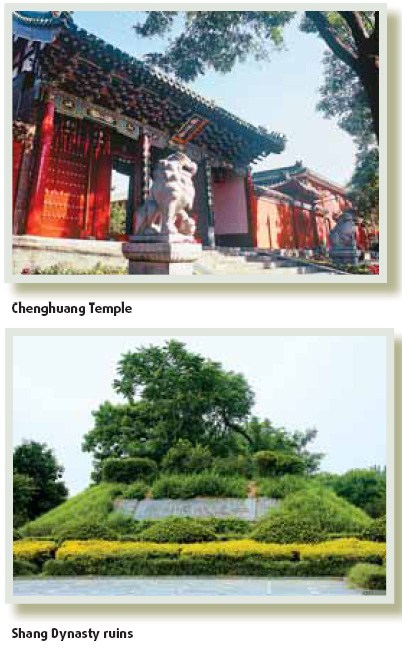
Chenghuang Temple
Chenghuang Temple, or the Temple of the City God, in downtown Zhengzhou was built to consecrate gods believed to be protecting the urban area and its people.
Built during the Ming Dynasty (1368-1644 AD), the temple was a structure of imposing beauty with many halls and grand gates.
The temple today has lost much of its religious function and become a place for exhibitions of art and culture. A mural along three of the walls in the temple's main hall depicts the morals of the socialist revolution, clearly showing changes have come to the former religious site.
The buildings, although renovated, still retain a typical Ming style, while the decor is impressive - wood and brick carvings, elegant roof and mural designs and an abundance of phoenix and dragon sculptures.
Its wooden lattice windows are particularly characteristic, making it a bit easier to imagine the temple in all its old glory. The highlight of the site is a statue of the City God Chenghuang in the main hall dressed in judicial costume.
A Cultural Temple Fair has been held in the temple every Chinese Lunar New Year to provide visitors and locals a chance to experience the folk culture of central China.
Zhongyue Temple
Located at the foot of Huanggai Peak in the Songshan Mountains, Zhongyue Temple is one of the best-preserved ancient sites at the five most-important mountains in China.
Initially built in the Han Dynasty (206BC-25AD) and rebuilt during the reign of Emperor Qianlong (1736-1796) of Qing Dynasty, the temple has the same design and architectural style of the Forbidden City in Beijing. It has 400 halls covering 100,000 sq m.
Among its 11 main buildings, the most famous and splendid is Junji Hall that covers 920 sq m at a height of 20 m.
Shang Dynasty ruins
Located in downtown Zhengzhou, the Shang Dynasty (16th-11th century BC) city ruins cover 25 sq km.
Remnants of a 7-km-long rampart from the ancient city wall still visible today have yielded a number of relics, including two rare square copper pots used by the imperial court.
In 1955, archaeologists found ruins of house foundations, cellars, wells, ditches, and graves. Ornaments and tools made of bronze, stone, bone, shell and jade have also been unearthed, as well as pottery and primitive porcelain.
'Shaolin in the Wind'
A combination of martial arts, folk music and dance performed by monks from the Shaolin Temple, birthplace of kungfu, and the cream of the Zhengzhou Song and Dance Troupe, the play is China's latest theatrical export to North America.
An old tale told in contemporary style, "Shaolin in the Wind" is a love tragedy.
The story tells how Tianyuan and his sweetheart Sushui are separated during an invasion. Tianyuan is badly injured and nursed back to health by the monks of the Shaolin Temple.
Unbearable yearning for his sweetheart, who is in the hands of the enemy, compels him work furiously to learn martial arts. Years later, the lovers are reunited, but Sushui sacrifices herself in order to save Tianyuan from an enemy weapon.
Overcome with grief, Tianyuan leads the Shaolin monks in expelling the enemy. He then dedicates himself to Buddhism and the martial arts.
The drama was inspired by traditional Henan folk dances, folk songs and operas.
Visitors who want to take in the sights of Henan will be pleased with the province's relatively mild climate. Its hottest month July has an average temperature of about 27 C.
(China Daily 12/22/2009 page6)