Zhengzhou
Ancient capital strides toward modern metropolis
By Te Kan (China Daily)
Updated: 2009-12-17 07:59
 |
Large Medium Small |
|
After six years of development, Zhengdong New District is now the core business area in Zhengzhou. |
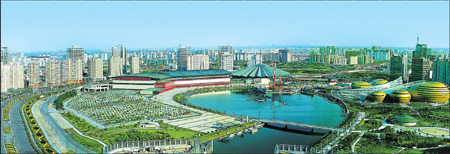
Zhengzhou, a historic city on banks of the Yellow River, has developed into a dynamic business hub in central China through booming trade, logistics and well-developed transport and communications links.
The capital of Henan province, Zhengzhou has been considered the "geographic center" of China throughout the nation's history. It covers nearly 7,500 sq km and has a population of 7.43 million.
One of the cradles of Chinese civilization, the city today retains the remnants of the splendid culture from its status as one of the country's eight ancient capitals.
Zhengzhou was the capital of the Xia (2100 BC-1600 BC) and Shang (1600 BC-1100 BC) dynasties. Recent archaeological discoveries show that the city was settled 8,000 years ago, long before recorded history began.
It was also the birthplace of Huangdi, or the Yellow Emperor, who is recognized as the ancestor of Chinese people.
Its long history, culture and unique landscape combine to make Zhengzhou an attractive tourist destination.
Every year, millions of tourists travel to the city see its many historical sites or visit Shaolin Temple - the birthplace of Chinese martial arts, or kungfu - and to venerate the Yellow Emperor in his hometown near the Yellow River.
Songshan Mountain, home to the Shaolin Temple, is also a world geopark recognized by UNESCO.
Transportation
Today, the ancient city retains its central position on China's economic map as one of the most important transportation hubs in the nation.
Two of the country's most important railways - the Lanzhou-Lianyugang and Beijing-Guangzhou lines - converge in the city.
At the heart of China's railway network, Zhengzhou North Railway Station is the largest switching yard in Asia, while Zhengzhou East Railway Station is the largest bulk cargo railway trans-shipment station in China.
The city is also the nexus of several important expressways linking to Beijing and Zhuhai, Lianyungang and Horgos.
The Zhengzhou Airport has flights to more than 30 cities in China.
The city is also one of the nation's key production bases for non-ferrous metals, food, coal, automobiles, building materials and textiles.
|
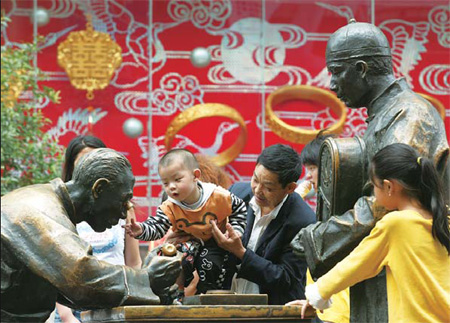
Sculptures in Dehua Street showing Zhengzhou's traditional lifestyle attract both locals and tourists. Dehua is the largest pedestrian street in central China. |
Its production of aluminum oxide accounts for more than half of the nation's total. The Zhengzhou Commodity Exchange is China's leading futures market for grains and cotton.
In recent years Zhengzhou has entered a new stage of economic and social development. In 2008, the city's gross domestic product exceeded 300 billion yuan, ranking it eighth among all provincial capitals.
The city has recently enhanced its international economic ties as businesses from more than 40 countries and regions have made investments in Zhengzhou.
The Zhengdong New District, founded in 2003, is the major investment destination for that investment. In the past six years, businesses from home and abroad started more than 3,000 enterprises in the area.
Ambitious plan
In the next two decades, Zhengzhou is scheduled to become an internationalized modern city with good living and business environment, while continuing to showcase the splendid Chinese culture to the world, according to a new growth plan for 2008-2020 released by the city government.
The plan said the new orientation for Zhengzhou is to become a modern manufacturing base as well as hubs for regional logistics and financial services.
To reach those goals, the city government plan calls for development of new urban areas and development zones, including the Zhengdong New District, Zhengzhou Economic and Technological Zone, the Zhongmu Industrial Base and the Zhengzhou International Logistics Park.
The Zhengdong New District is designated as the central business district in Zhengzhou emphasizing finance and other modern service industries. It is also expected to become the site of regional headquarters of numerous domestic and international companies.
In the next two decades, Zhengzhou will highlight development of industries such as modern agriculture, food processing, logistics, automobiles and auto parts, non-ferrous metallurgy, electronic information, textiles, finance and tourism.
|
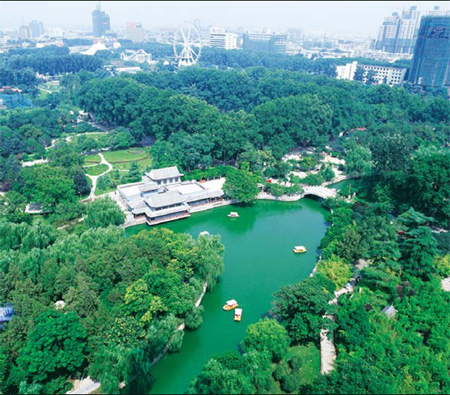
City efforts in environmental protection have resulted in a marked improvement in the local ecology in recent years. |
(China Daily 12/17/2009 page7)