REGIONAL> Society

|
REGIONAL> Society
|
|
China's job market still grim as exports falter
(China.org.cn)
Updated: 2009-04-09 15:06
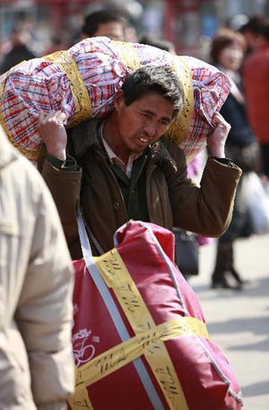
A migrant worker arrives in a railway station to try to find a job in the city.[Xinhua] Zhang De, a migrant worker from Sichuan Province, returned to Guangzhou shortly after Spring Festival in search of a job. Still searching two months later, he is torn between staying in the industrial heartland and going back to his rural hometown. Zhang is desperate to find a job before he runs out of money and has to leave Guangdong, the province that has been home to China's export-driven boom over the last three decades. The global financial crisis caused many small export-oriented factories in China's coastal regions to close, leaving millions of workers without jobs. Guangdong Province accounts for nearly a third of China's exports, making it especially vulnerable as western retailers cut back on orders and focus on clearing the inventory they have already piled up. According to the Labor and Social Security Department of Guangdong Province, 9.46 million migrant workers returned to the province after the holiday. Many had jobs lined up, but 2 million came in search of work. April and May should have been the high season for manufacturers here, but the crisis has changed the economic climate drastically. Orders are showing no signs of recovering. Many enterprises are running with a skeleton staff and waiting for the economy to improve. "In the past three months, orders have continued to slump," said Guo Weiwen, secretary-general of a local shoe makers' association. "For large enterprises, orders have fallen by 30 to 40 percent, and for small ones the situation is even worse." "With nothing to do, enterprises are unwilling to recruit workers," he added. Wu Zhenchang, who owns a shoe factory in Guangzhou, has seen orders shrink since last year, as consumers in the United States, the EU and Japan lose confidence in the economy and, as a result, cut back on their spending. "It will be difficult to turn things around in a short space of time," he said. His factory is one of many now operating at half capacity and trying to keep going by axing jobs. "We have cut our workforce from 20,000 workers to 13,000. If the situation worsens, we will have to let more workers go," said Wu. As demand dries up in the overseas market, many exporters have turned to tapping the domestic market that they previously overlooked. But it is not easy to build up domestic orders that currently account for less than 10 percent of sales, Wu said. The rising cost of labor is another headache for exporters. They have to pay at least 2,000 yuan (294 U.S. dollars) per month on average per worker to cover wages, social insurance and other sundry expenses. In the face of eroded profits and an uncertain future, foreign-owned businesses, which control the bulk of Guangdong's foreign trade, have pruned back investment. A recent survey indicates that Guangdong Province approved just 699 foreign direct investment projects in the first two months of this year, down 48.6 percent from the same period last year. In 2008, 2,542 foreign-funded enterprises in Guangdong closed or left the province, up 14.1 percent compared with a year earlier. Faced with mounting pressure on the job market, Guangdong is searching for ways to assist job hunters. In cooperation with labor-exporting provinces such as Hunan, Sichuan and Jiangxi, Guangdong is now offering training programs to improve workers' skills. Chambers of commerce are also stepping in to help. In March, the American Chamber of Commerce in south China urged its members to continue recruiting during the downturn in anticipation of the coming recovery.
|
九龙县| 民和| 嘉定区| 青神县| 石阡县| 威远县| 通江县| 岑溪市| 嘉兴市| 柏乡县| 尼玛县| 谷城县| 衢州市| 五台县| 西畴县| 于都县| 布尔津县| 迭部县| 新郑市| 康平县| 永靖县| 阳江市| 五原县| 甘洛县| 石台县| 长顺县| 岳西县| 吴堡县| 苏尼特右旗| 慈溪市| 丹巴县| 南皮县| 汉川市| 同仁县| 镇赉县| 阳山县| 新河县| 万安县| 广元市| 精河县| 多伦县|