World
Fewer behaviour problems for breastfed kids: study
(Agencies)
Updated: 2011-05-10 14:35
 |
Large Medium Small |
|
 |
|
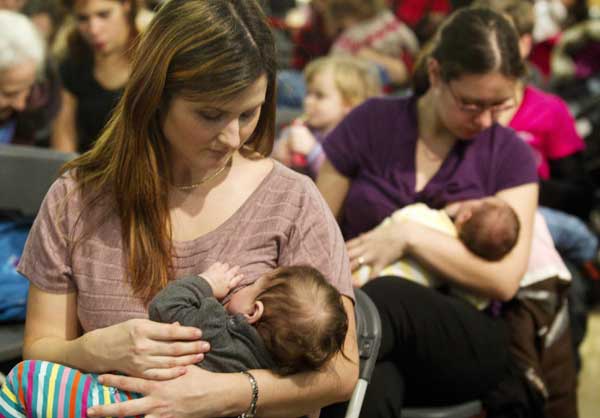
Mothers breastfeed their children in front of a clothing store in a shopping mall in Montreal in this January 19, 2011 file photo.[Photo/Agencies] |
LONDON - Babies who are breastfed are less likely to grow into children with behaviour problems by the time they reach the age of five than those who receive formula milk, scientists said on Tuesday.
In a study in the Archives of Disease in Childhood journal, British researchers used a "strengths and difficulties" questionnaire completed by parents about their children and found that abnormal scores were less common in children who were breastfed for at least four months.


"Mothers who want to breastfeed should be given all the support they need. Many women struggle to breastfeed for as long as they might otherwise like, and many don't receive the support that might make a difference," she said in a statement.
Some benefits of breastfeeding are already well known - for example breastfed babies have lower rates of infections, and mothers who breastfeed have a reduced risk of breast cancer.
A range of other health and child development benefits have also been suggested - such as fewer behavioural problems and lower levels of obesity - but the British team said evidence for these has been inconsistent across different studies.
In this study researchers from the universities of Oxford, Essex, York and from University College London used a nationwide British survey of babies born in 2000-2001 called the Millennium Cohort Study and included data for more than 9,500 mothers and babies born at full term to families of white ethnic background.
They used data on whether mothers had breastfed and how long for and combined these with the results of the "strengths and difficulties" questionnaire used for identifying children with possible behavioural problems.
They found abnormal scores for the questionnaires, which indicate potential behavioural problems, were less common in children breastfed for at least four months - at 6 percent -than in formula fed children - at 16 percent.
The lower risk of a full-term breastfed child having abnormal scores for behaviour was also evident even when the researchers took into account other important influences such as socio-economic or parental factors.
"We're not necessarily talking about tearaway, unmanageable five-year-old kids," said Quigley. "It might be unusual anxiousness, restlessness, inability to socialise with other children or play fully in groups."
The researchers said one possible reason for the findings was that breast milk contains large amounts of essential long chain polyunsaturated fatty acids, growth factors and hormones which are important in brain and nervous system development.
The results might also be explained by the fact that breastfeeding leads to more interaction between mother and child and better learning of acceptable behaviours, they said.
Peter Kinderman, a professor of clinical psychology at the University of Liverpool, who was not involved in the study, said it was a good piece of research with important findings.
"Positive bonding between parent and child is known to be fantastically helpful for development," he said. "This is more evidence of the importance of breastfeeding and mother-baby attachment, not just for physical health but also for the psychological development of the child."
| 分享按鈕 |