 |
|
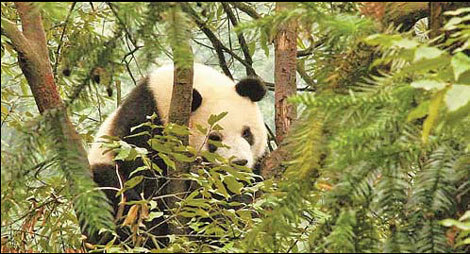
A giant panda at the Fengtongzhai national reserve in Ya'an, Sichuan province. Zhang Guofang /for China Daily |
Beijing - Giant pandas may be shifting their habitats northward because of the combined impact of climate change and the 2008 earthquake in Sichuan province, a senior panda researcher has said.
Warmer and drier weather will destroy the bears' food supplies, while the 8.0-magnitude quake has shrunk their current habitat, said Ling Lin, deputy executive director of the Chengdu program office of the World Wide Fund for Nature (WWF).
| ||||
But the annual average temperature of the main panda habitats has increased while annual precipitation has dropped in the past 50 years, Ling told China Daily.
"Climate change will have an impact on the growth of arrow bamboo, a staple of giant pandas. They will also lose their homes as some forests shrink gradually because of the warming weather," Ling said.
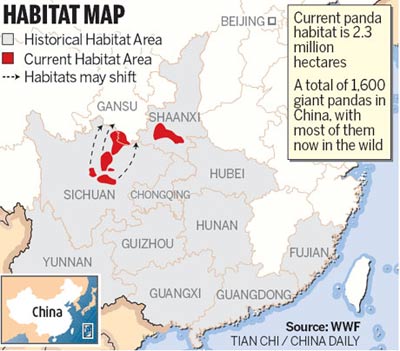
Since the pandas thrive in heavily forested areas with temperatures usually below 25 C, their habitat is expected to shift northwards to areas like Gansu, Ling said.
The giant panda is regarded as a "living fossil" because its ancestors are thought to have lived in China more than eight million years ago. Its habitats once covered wide regions south of the Qinling Mountain, such as Hunan, Hubei, Shanxi, Gansu, Shaanxi, Yunnan and Guizhou provinces.
But its current habitat totals 2.3 million hectares and is only 0.01 percent of its previous size, due to forest logging and invasion by human residential areas and farmland, Ling said.
There are about 1,600 giant pandas in China and most are now in the wild, figures from the Third National Giant Panda Survey in 2004 showed.
The Sichuan quake has also affected the giant pandas' habitat, Ling said.
While no pandas were reported killed in the quake, 2.5 percent of their habitat nationwide had been damaged by landslides, lakes and debris-flow caused by the disaster, according to remote sensing and field investigations by the Sichuan wildlife resource investigation and protection station, the WWF and the ecological environment center of the Chinese Academy of Sciences.
The damage was even more serious in areas such as those south of Minshan Mountain, where nearly 35 percent of giant pandas' habitats have been lost.
"There are only 35 giant pandas south of the Minshan Mountain now," Ling said.
"The fragmentation of their habitat will further worsen due to large-scale infrastructure building after the earthquake. Close breeding will threaten their safety in the future," he said.
So far, 62 nature reserves covering 1.7 million hectares have been set up to protect more than 51 percent of the giant panda habitats.
"We are considering helping the government to build more corridors to link habitats with each other and set up more nature reserves north of the current main habitats, especially in Gansu province, which will be more suitable for giant pandas," Ling said.




Copyright 1995 - . All rights reserved. The content (including but not limited to text, photo, multimedia information, etc) published in this site belongs to China Daily Information Co (CDIC). Without written authorization from CDIC, such content shall not be republished or used in any form. Note: Browsers with 1024*768 or higher resolution are suggested for this site.
License for publishing multimedia online 0108263 Registration Number: 130349