CHINA> Top pic

|
CHINA> Top pic
|
|
First fuzzy photos of planets outside solar system
(Agencies)
Updated: 2008-11-14 07:55
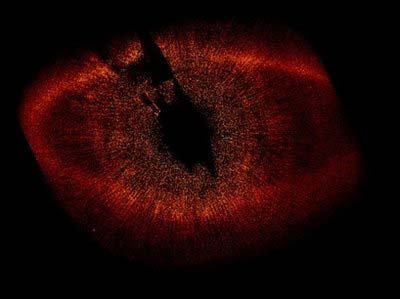
MIT planetary scientist Sara Seager, at the NASA press conference, said earlier planetary claims "are in a gray area." But these discoveries, "everybody would agree is a planet," said Seager, who was not part of either planet-finding team. The Hubble team this spring compared a 2006 photo to one of the same body taken by Hubble in 2004. The scientists used that to show that the object orbited a star and was part of a massive red dust ring which is usually associated with planets, making it less likely to be a dwarf star. Macintosh's team used ground-based telescopes to spot three other planets orbiting a different star. That makes it less likely they are a pack of brown dwarf stars. The planet discovered by Hubble is one of the smallest exoplanets found yet. It's somewhere between the size of Neptune and three times bigger than Jupiter. And it may have a Saturn-like ring. It circles the star Fomalhaut, pronounced FUM-al-HUT, which is Arabic for "mouth of the fish." It's in the constellation Piscis Austrinus and is relatively close by, a mere 148 trillion miles away, practically a next-door neighbor by galactic standards. The planet's temperature is around 260 degrees, but that's cool by comparison to other exoplanets. The planet is only about 200 million years old, a baby compared to the more than 4 billion-year-old planets in our solar system. That's important to astronomers because they can study what Earth and planets in our solar system may have been like in their infancy, said Paul Kalas at the University of California, Berkeley. Kalas led the team using Hubble to discover Fomalhaut's planet. One big reason the picture looks fuzzy is that the star Fomalhaut is 100 million times brighter than its planet. The team led by Macintosh at Lawrence Livermore found its planets a little earlier, spotting the first one in 2007, but taking extra time to confirm the trio of planets circling a star in the Pegasus constellation. They are about 767 trillion miles away, but are actually visible with binoculars. The star in this solar system is HR 8799, and the three planets are seven to 10 times larger than Jupiter, Macintosh said. "I've been doing this for eight years and after eight years we get three at once," he said. |
孟连| 清丰县| 独山县| 龙陵县| 深圳市| 峡江县| 舒兰市| 林芝县| 新蔡县| 太谷县| 潞西市| 荣成市| 股票| 隆安县| 孙吴县| 施甸县| 沂水县| 三都| 筠连县| 土默特左旗| 五峰| 烟台市| 炉霍县| 准格尔旗| 五原县| 甘孜县| 襄垣县| 钟祥市| 葵青区| 四平市| 通城县| 萨迦县| 井陉县| 如皋市| 中牟县| 修文县| 夏河县| 通州市| 新建县| 鹤峰县| 盐边县|