BEIJING -- Although Dutch woman Esther Vergeer lost the doubles final with her partner Jiske Griffioen in full sets on Monday, the wheelchair tennis star still rules the singles world and keeps the winning streak at the Beijing Paralympic Games.
|
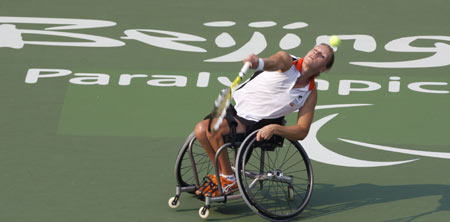
Esther Vergeer of the Netherlands returns a shot to Korie Homan of the Netherlands during the Women's Singles wheelchair tennis Gold Medal Match at the Beijing 2008 Paralympic Games September 14, 2008. [Agencies]
|
She and Griffioen had once had the chance to pull them back into play while holding off one match point at 5-4 down on the opponents' serve in the third set. They even produced two break points in the game but finally bowed out on the second match point.
"It was disappointing for us, because we know that we could play better," said Vergeer on Monday, who just added a singles gold medal of the Beijing Paralympics to her four won in singles and doubles at the Sydney and Athens Games.
"The match was just not one of our best matches. We said to each other that maybe tonight or after a couple of days, I mean, we are still very proud of that silver medal."
It seems that Vergeer is still in a party mood. At least, she knows more about dominating tennis streaks than Rafael Nadal, Roger Federer or the Williams sisters -- the 27-year-old hasn't lost in 349 singles matches of wheelchair tennis, a string that dates back five and a half years. There is no statistic quite like it in sport.
|
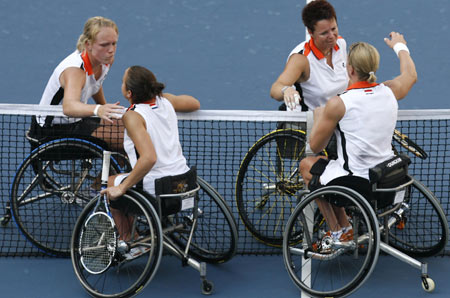
Netherlands' Korie Homan (L) and Sharon Walraven (2nd R) greet compatriots Esther Vergeer (R) and Jiske Griffioen (2nd L) after defeating them in the wheelchair tennis women's doubles final during the Beijing 2008 Paralympic Games September 15, 2008. [Agencies]
|
"The pressure was high because everyone was talking about it, saying 'you've had this streak,' and 'you haven't lost for so long.' I felt that pressure, and when I play I sometimes think 'oh my god this is going to be the day (I lose),'" said Vergeer, a celebrity in the Netherlands, which is also the country with the world's best wheelchair tennis players.
"They remind me of the statistics rather than my way of playing, but I just want to improve my game as much as I can. That is my goal and my motivation. The winning streak is not my motivation."
But even Vergeer gets jittery on not losing a match since January 2003. "I would rather have lost before the Paralympics than during the Paralympics. I mean, I will lose matches one day, better it's earlier so I can take off the pressure," said the long-time world number one.
Vergeer, born on July 18, 1981 in Woerden in central Holland, has been in a wheelchair since the age of eight, when surgery to correct defective blood vessels around her spinal cord left her unable to walk.
She took up wheelchair sport as part of her rehabilitation, something strongly encouraged in Holland -- anyone who loses the use of their legs receives a free sports chair from the government, as well as the option of a year's training in any chosen sport. After three years, anyone still in training gets a new chair.
This helps explain why so many of the best wheelchair tennis players are Dutch -- all the top four women are and one of the top three men is, too.
"The national federation for tennis is the same federation for wheelchair tennis, so we are treated as equal. The Dutch National Olympic Committee also treats the disabled athletes the same as the able bodied athletes so I think it is a combination of those things," she said.
Ten years ago, Vergeer was a teenage wheelchair basketball player on the fringes of the Dutch squad. She had entered a few tennis events and found the individuality of the sport appealing. She switched to tennis full-time in 1998 and rather to her surprise, Vergeer discovered she was the best player in the world.
"I think tennis is such a complete sport. There is the physical part, the mental part. I mean it has everything. And if one of those aspects is not at its best, your tennis is not at its best. Everything has to be, like a puzzle, everything has to fit. You know, it's an individual sport, so if you screw up, it's your fault. But if you win, you can tap yourself on the shoulder."
Within months of giving up basketball for tennis, she won the US Open. Within a year, she was world number one, and within two, a Paralympic gold medallist. Almost by accident, she found herself at the pinnacle of her sport.
"I will play the best that I can play. If I train back at home I want to improve myself every single time I train, and I do that because I set goals. I train against guys because they're stronger and faster. I want to get the best out of myself and I know the best is not yet reached."
Vergeer's dominance has earned her celebrity in the Netherlands, two Laureus awards (Sportswoman with a Disability of the Year), enough sponsorships to turn professional and her own personal foundation.
"Besides tennis, I'd love to contribute something to society. I run my own foundation to help little kids with a disability to get involved in sports. In the future I'll do more stuff like that," Vergeer said.

