Meal gave scholar taste for China-US links


 |
|
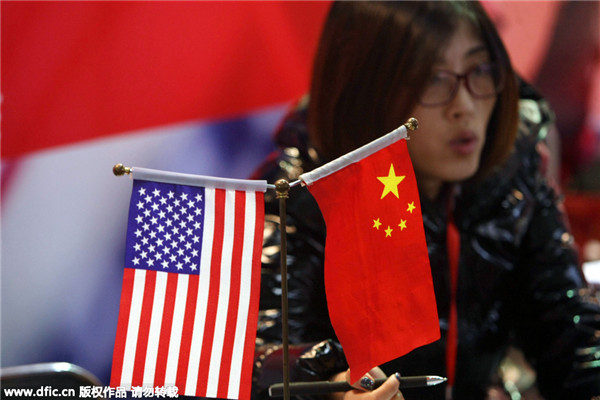
File photo shows the national flags of China and US. [Photo/IC] |
 |
|
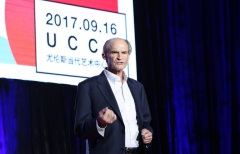
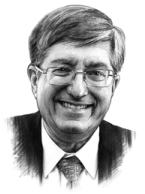
Jeffrey S. Lehman, vice-chancellor of NYU Shanghai [Photo/China Daily] |
At the time, he was dean of the University of Michigan Law School and had been invited to China on a business trip. The aging academics, all former faculty at the school, suggested grabbing dinner after hearing he'd be in town.
The professors had helped establish Soochow University Law School in Shanghai in the 1930s. Although the school was closed two decades later, they had all stayed in the city.
"Meeting these people in their 90s, for whom the connection between China and the US had been a big part of their lives, was very emotional for me," Lehman recalled. "They were talking about how symbolically important it was for them that Michigan was coming back to China.
"It had a deep impact on me, and I started thinking about how I wanted to live my life and try to make a contribution. I felt like I was given this opportunity to be a bridge between the US and China."
Lehman went on to become president of Cornell University in New York state, where part of his job was to renew its relationship with China.
In 2008, he accepted his first appointment in China, becoming the first dean of Peking University's School of Transnational Law, which is based in Shenzhen, Guangdong province.
Four years later, he received calls from New York University and the Chinese government asking him to serve as vice-chancellor of NYU Shanghai, the first China-US joint university. He has lived in the eastern metropolis ever since.
"Each year I'm here, I feel more and more rooted in the city," said Lehman, 60, who remarked on the tremendous changes in the city over the past five years.
In particular, the city's art scene has blossomed, he said. "It seems that every time you turn around there's another museum or art gallery opening. You just feel in the city right now a kind of creative energy that makes you happy to get out of bed every morning.
"What I also love about Shanghai is everywhere you look, there's someone from somewhere else," he added. "When I walk on the street I hear Chinese, English, French, German, Dutch and Japanese, and so on."
Yet it is not a recent feeling that Shanghai, and China as a whole, is developing rapidly, according to Lehman.
From his eye-opening trip in 1998, he also recalled a hotel porter who, after helping to carry the US scholar's bags to his room, had asked in fluent English, "Has anyone ever told you that you look a lot like Bill Gates?"
"That was in 1998, and this man spoke terrific English and knew what Bill Gates looked like well enough to make this match. I thought then that China was opening up on a fast track," Lehman said.
Lehman worked for two years in Paris, where he said people can meet citizens from across France and get a sense they have all come to build something important together.
He had that same sense in Shanghai, he said. "I feel like a huge percentage of people come here from elsewhere because there is a sense this is a place that is supposed to be built into something really special to serve the whole country.
"When talented people gather together in one place, great things happen," he added.
NYU Shanghai, which has been designed to produce global citizens for an increasingly globalized world, graduated its first class this spring-more than 260 students from 33 countries.
"We're so proud of them, and we cared deeply to make sure they didn't regret their choice, as they came to a school that did not exist while turning down opportunities to go to famous, well-established schools," Lehman said. "They believed in the concept of NYU Shanghai and believed it would be beneficial to them."
About half of the Class of 2017 will go to graduate schools, mainly in the US, while the rest will find jobs, he said, adding that at least 10 international graduates will work in Shanghai.
- China-US ping-pong diplomacy commemorated in NY, Chicago
- China-US trade war leads nowhere: FM
- China, US share early childhood education resources
- Expert sees weakened China-US relationship
- China, US trade to take front row seat
- By talking, China, US assure world: Cui
- China-US economic dialogue lack of progress due to excessive US demands: Sputnik