Connectivity as an engine for innovation - the Israeli perspective on BRI


I. BRI means connectivity, and connectivity is an engine for innovation.
The grand Belt and Road Initiative (BRI) is promoted as a project of connectivity for the Euro-Asian landmass. Connectivity facilitates trade, and ultimately, boosts economic development. Under this equation, BRI initially targets infrastructure related project, e.g. railways, roads and ports, the veins of modern trade. Israel is included in the BRI and Chinese companies play a significant role in developing and modernizing Israel's public infrastructure. This includes the construction and running additions to the two major Israeli ports (of Haifa and Ashdod), digging infrastructure tunnels for the northern railway connection, and the tunnels for the future Tel Aviv metro system, among others.These are all important projects which relate directly to the obvious scope of the BRI.
The BRI however does not focus merely on connectivity in a narrow sense of "transportation". Connectivity entails a broader meaning of bridging gaps and
enabling trade partners from different countries to integrate their businesses and activities. The BRI framework includes many projects that promote connectivity in a much broader sense. For example, China founded industrial parks and centers along the BRI routes, creating new-shared business hubs for local and Chinese companies. This strategy provides a fertile platform for the growth of innovation along the BRI. The China – Israel experience of using innovation as a cornerstone for the development of their relations, is highly relevant to emphasize this point.
II. The China - Israel Comprehensive Innovation Partnership.
China and Israel have recently jointly announced a new "Comprehensive Innovative Partnership". This important status was announced last March in Beijing, during the commemoration of 25 years to the establishment of full diplomatic relations between the two nations. Israeli Prime Minister Benjamin Netanyahu received a warm welcome meeting with President Xi Jinping, Prime Minister Li Keqiang, and Supreme Legislator Zhang Dejiang. The title of the partnership between China and Israel is founded on many years of experience.
Over the last decade, Israeli companies promoted their advanced technologies in China, commercializing their know-how and intellectual property. Israel is too small for scale-up, and creating new and bigger markets is essential for the success of Israeli innovation. Over the years, advanced Israeli technology was used for the modernization of agriculture, water management, desalination,communication and other hi-tech industries. These projects have all helped to cement the reputation of Israel as a start-up nation. This coincided with the rejuvenation strategy pursued by Chinese leaders over the reform period,emphasizing the introduction of advanced foreign technology projects.
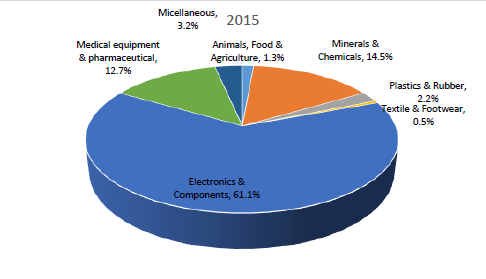
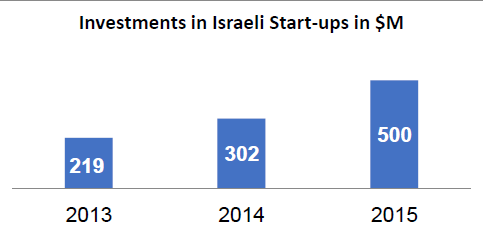
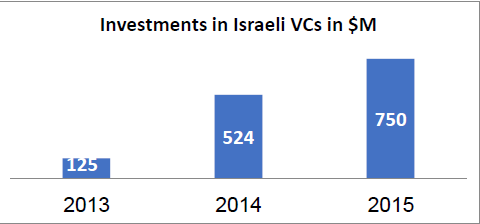
Innovation is the main driving force of the China-Israel partnership, as demonstrated in the analysis of trade and investment patterns between China and Israel in the charts below.
 |
|
Chart I: Israel Export to China 2015 composite –More than 70% of export is technological innovation-related, including electronics components, medical equipment and pharmaceutical.Source: Israel Ministry of Economy |
 |
|
Chart II: Chinese investment in hi-tech companies in Israel.Since the launch of BRI, within the first two years Chinese investment in Israeli start-ups has doubled. Source: Israel Ministry of Economy |
 |
|
Chart IV: Chinese investment in Israeli VCs. Since the launch of BRI, within the first two years, Chinese investment in Israeli venture-funds has grown nearly five-fold.Source: Israel Ministry of Economy |
In conclusion, since the launch of BRI multiple opportunities for business innovation between China and Israel are continuously sprouting. This is an obvious trend that can be identified by observing the analysis of the trade and investment patterns between China and Israel since the launch of BRI. Final data with regard to 20 6 was not available at the time of writing this short note, however, it is expected to show the similar positive trends identified above.
III. Forthcoming Trends for China and Israel Comprehensive Innovation Partnership in view of BRI
China and Israel have recently vowed to strengthen their economic cooperation with innovation as an underlying theme. For this purpose, the two countries are negotiating a free trade agreement that will further reduce barriers to trade and improve connectivity. Following the conclusion of such FTA, it is estimated that the volume of trade and investment shall further increase.
Considering that the China - Israel relationship is strongly founded on innovation, it is expected that the BRI will only continue to stimulate the development of the economic relations between these two partners.