A new era for human rights across the world
In the report he delivered at the opening of the 19th National Congress of the Communist Party of China on Oct 18, General Secretary Xi Jinping said that as a result of the transformative changes that have been made during the past five years, the country is better prepared than ever before to take on the challenges in the new era.
One of the many fields in which China has made significant progress over the past five years is human rights. This is exemplified by the book published on the eve of the congress titled China's New Achievements in Human Rights (2012-2017). One of the achievements the book highlights is the strengthening of the rule of law since the Fourth Plenary Session of the 18th CPC Central Committee in 2014. An ambitious agenda was adopted at this plenum, with special emphasis on judicial reform, and it has since been implemented with speed and conviction. Like anywhere else, there are miscarriages of justice in China, but many measures are now in place to try and prevent them.
Another significant human rights achievement that has been made over the past five years has been the lifting of 14 million people out of poverty each year with the help of narrowly targeted programs. Furthermore, during the same period the average life expectancy in China has risen by 18 months and is now close to 76.5 years.
China is also actively promoting people's right to development, and it has devoted a white paper to this, and it held an important conference in Beijing on the topic at the end of last year.
China's new era in human rights is not limited to developments at home, but also extends to making contributions in the international arena. Thus, China has become a major contributor to UN anti-piracy and peacekeeping operations, to which it has committed more troops than any other permanent member of the Security Council.
China's presence in the international human rights discourse is also becoming more evident, and it is offering Chinese wisdom to tackle international human rights problems. Increasingly, delegations from other UN member states are looking toward the Chinese Mission in Geneva for guidance, coordination and leadership. And by organizing side events, nongovernmental organizations such as the China Society for Human Rights Studies have made international audiences more aware of China's human rights policies.
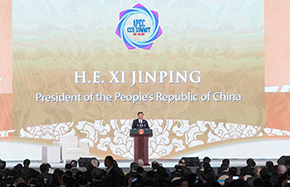
The expectation is that China's role within the international human rights community will further increase during the next five years. An indication of this was the speech delivered by President Xi Jinping at the Davos World Economic Forum at the beginning of this year.
According to Xi, the global governance system has not adapted to the changing global situation over the past few decades, such as the emergence of developing countries. The lack of representativeness and inclusiveness in global governance needs to be addressed by building a community of shared future for mankind.
Building a community of shared future for mankind requires all voices be heard, not only those of the developed countries. This means tapping into the wisdom and knowledge of all people and societies. Building a community of shared future for all mankind, as proposed by Xi, means that all countries will become full stakeholders in the global governance system.
As Xi indicated in his report to the 19th CPC National Congress, China has developed its own independent path toward modernization and development, while relying on socialism with Chinese characteristics and traditional Chinese values. As he suggested, this path can serve as a model for other countries and nations.
South-South cooperation in the area of human rights is part of this common journey. For this reason, China is hosting a conference in December to explore closer South-South human rights cooperation.
The author is a professor of cross-cultural law at Utrecht University and general secretary of the Cross-cultural Human Rights Centre.