Election win doesn't mean Abe can amend Constitution
 |
|
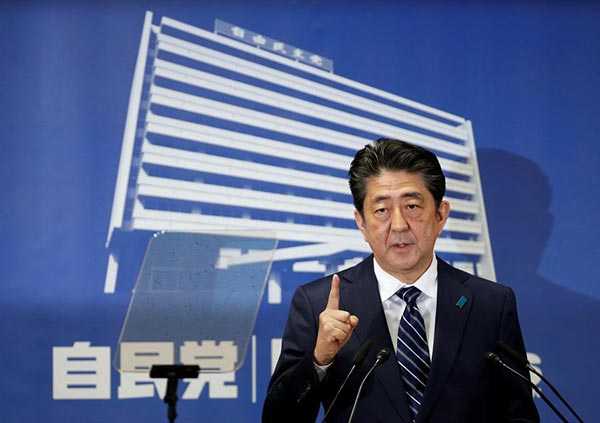
Japan's Prime Minister Shinzo Abe, who is also leader of the Liberal Democratic Party (LDP), attends a news conference at LDP headquarters in Tokyo, Japan, Oct 23, 2017. [Photo/Agencies] |
The Liberal Democratic Partyled ruling coalition secured two-thirds majority in the lower house of Parliament with almost all results decided on Sunday, taking Abe one step closer to a record third term. And Abe would become the longest serving Japanese prime minister in the modern era if he remains in office until 2020.
Despite a string of alleged cronyism scandals and the ensuing approval rate crisis earlier this year, Abe managed to regain some footing and won a major gamble of calling an early election. The rewards may be bountiful for Abe but carry mixed implications for Japan and other countries.
It is no secret that Abe wants to revise Japan's pacifist Constitution to address "increasing security threats, an aging society and the need for economic revival". Among the most contentious proposed revisions is the one seeking to add a clause to Article 9 of the Constitution-which in its present form says Japan will not maintain armed forces to ensure it does not wage a war again-to transform Japan Self-Defense Forces into a full-fledged military.
The ruling LDP-Komeito coalition has reportedly won 313 of the 465 seats in the lower house. And any amendment to the Constitution first requires two-thirds approval of the parliament, and then a simple majority in a public referendum.
Although Abe looks set to gain sufficient support for constitutional revision in parliament, whether he will get majority support in a referendum is not clear. In an NHK survey before the election, 32 percent of the respondents said they support Abe's proposal, while 21 percent opposed it and 39 percent were uncertain.
What made Abe's huge election victory possible were an opposition in disarray, a factor he sought to capitalize by dissolving the lower house last month to force the snap polls, as well as economic recovery and the support of younger generations, even bad weather.
The Party of Hope, led by Tokyo Governor Yuriko Koike, lost Tokyo No 10 district that used to be Koike's parliamentary base, wining a meager 49 seats. The Constitutional Democratic Party of Japan, formed by members of the has-been Democratic Party, won 54 seats and became the largest opposition party in the lower house. But neither party has enough numbers to make a difference.
"Abenomics", or Abe's economic policy of ultra-loose monetary policy and big fiscal spending, has taken effect, raising hopes of many Japanese people, especially young voters, stuck in a "survival crisis". In response to Abe's election win, the Nikkei Stock Average rose 1.1 percent in early Asia trade, registering a record 15th session of consecutive gains.
Bad weather often favors candidates who have well-mobilized supporters and chair the ruling party. When a powerful typhoon approached Japan last weekend, loosely organized "swing voters" were less likely to go out to the nearest polling stations to cast their vote, while LDP, with a record of mobilizing local voters, might have taken advantage of the former's absence.
An LDP-Komeito coalition on the fast track to constitutional revision does not mean Japan may be able to relive its military past at the cost of China-Japan relations.
There's a silver lining in the cloud: Trade exchanges between China and Japan remain active despite political tensions, strengthening their economic bond. And the United States, which drafted Japan's post-World War II constitution, will still have a say in the possible revisions.
Yu Qiang is a researcher in Japan studies at University of International Relations. The article is an excerpt from his interview with China Daily's Cui Shoufeng.