ROK firms' pullout reflects loss of edge
Trading pattern has to conform to changes

Jin Meihua, a researcher at the Northeast Asia Studies Institute at Jilin Academy of Social Sciences
The ROK and China both oppose the DPRK's pursuit of nuclear weapons. But the US and the ROK have always insisted that China play a bigger role in resolving the DPRK nuclear issue. Ridiculously, though, while pushing Beijing to do more, Washington and Seoul have added fuel to the fire by deploying THAAD in the ROK. Moreover, US President Donald Trump's continued diatribe against the DPRK, including his UN General Assembly speech on Tuesday, has further complicated the DPRK nuclear issue.
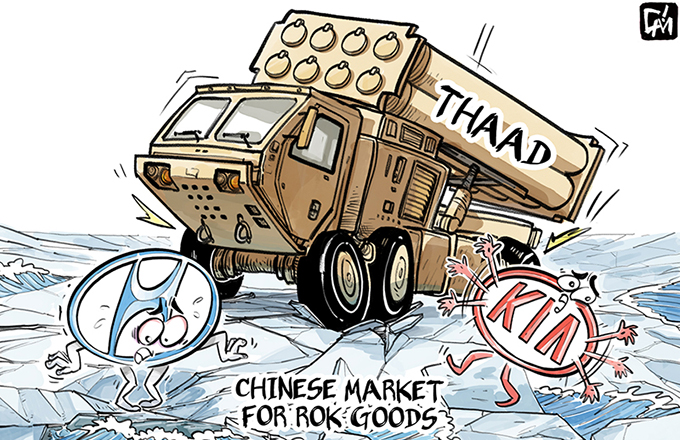
The THAAD factor is partly responsible for the ailing China-ROK economic ties. But it's a totally misunderstanding that China has official policies against ROK products. Chinese consumers make their own choices.
Other factors that have affected China-ROK economic ties are the changing trade structure and the rise of Chinese brands. Frequent battery explosions last year have undermined consumers' confidence in Samsung's smartphones, whose share in the Chinese market dropped to just 3.1 percent in the first quarter of this year from its peak of nearly 20 percent in the past five years.
Data show the ROK economy, despite the volatile regional situation, remains stable. The global demand for ROK goods improved in the second half of this year, and its exports are expected to increase 10.2 percent this year, according to the ROK government.
In contrast, some ROK enterprises have had a difficult time in the Chinese market, and the falling number of Chinese tourists to the ROK has also taken a toll on the latter's economy. The Chinabound investment by ROK enterprises even shows signs of negative growth.
With or without THAAD, the China-ROK trading pattern will have to change in the face of increasingly competent Chinese manufacturers and sophisticated industrial chains. To win back Chinese consumers, ROK entrepreneurs need to sell more value-added products to them and expand their operation to more Chinese cities.