Trump takes the wrong road to IP war
 |
|
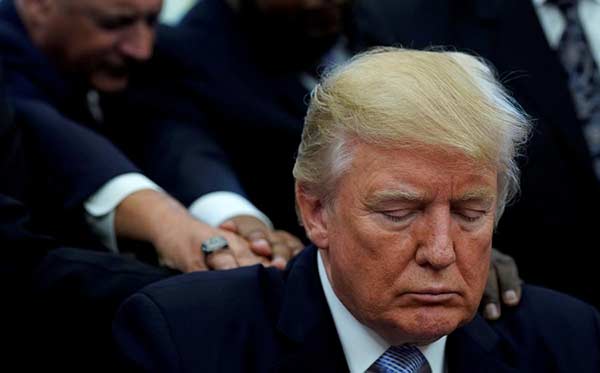
Faith leaders place their hands on the shoulders of US President Donald Trump as he takes part in a prayer for those affected by Hurricane Harvey in the Oval Office of the White House in Washington, US, September 1, 2017. [Photo/Agencies] |
In mid-August, President Donald Trump asked US Trade Representative Robert Lighthizer, a Ronald Reagan administration trade hawk, to open an investigation into China's intellectual property practices. And the first public hearing on China's trade conduct is scheduled for Oct 10 in Washington.
As Lighthizer initiated the investigation, he seized the notorious Section 301 of the US Trade Act of 1974, which in the 1980s was used against Japan, and which Japan and the European Union regarded as a violation of World Trade Organization rules. Instead of free trade, it represents "aggressive unilateralism" and authorizes retaliatory tariffs.
Lighthizer draws from the highly partisan US Commission on the Theft of American Intellectual Property, which was mobilized in the early 2010s amid the rise of China's indigenous innovation and foreign investment.
Using contested estimates, the commission assumes IP theft could be between $225 billion and $600 billion a year in counterfeit goods, pirated software and theft of trade secrets. As a result, it advocates more aggressive policy enforcement "to protect American IP".
Essentially, the US' IP narrative claims the Chinese government forces US companies to relinquish its IP to China. The narrative is consistent with Trump's "America First" policy and it has been quoted uncritically by the media but it is deeply flawed.
While foreign companies in China are often warned not to part with "too much" in technology transfer and IP deals, they are not forced by the Chinese government or other interested parties into those deals.
Moreover, in contested legal cases, the Chinese government has often supported foreign companies. As The Wall Street Journal reported last year, when foreign companies sue in Chinese courts, they typically win. From 2006 to 2014, foreign plaintiffs won more than 80 percent of their patent-infringement suits against Chinese companies, virtually the same rate as domestic plaintiffs.
For years, foreign multinationals have effectively exchanged their technology expertise for market share in China. The rush of IP companies to China intensified a decade ago amid the global crisis, when the Silicon Valley giant Intel opened a $2.5 billion wafer fabrication foundry in Dalian, Northeast China's Liaoning province. As advanced economies struggled with stagnation, China continued to grow vigorously. So the bet proved very lucrative.
At that time, Craig Barrett was Intel's chairman. Today Barrett is one of the five commissioners of the US IP Commission which portrays the US as a victim of massive IP fraud. Not surprisingly, some US observers see the Trump administration's IP investigation as less a scrutiny of forced technology transfers than a negotiation ploy.
In reality, much of China's IP progress can be attributed to past technology transfers and the government's huge investment in science and technology. And as Chinese companies have moved up the value-added chain, they stress the need for IP protection, particularly patents. In 2006, I wrote in the prestigious US foreign policy journal The National Interest that emerging Chinese multinationals were "no longer satisfied with imitating. Instead, they seek to convert cost advantages to more sustainable competitive advantages-often through innovation." Few took the contention seriously then.
Typically, the Trump IP debacle is escalating as Chinese companies join the global rivalry for cutting-edge innovation. In terms of the number of total patent applications, China's share has exploded. Two decades ago, it was far behind the US, Japan, the Republic of Korea and Germany, the world's leading patent players. Now it is ahead of all of them.
But in these rivalries, not all patents are of equal value. The so-called triadic patents, which are registered in the US, the EU and Japan to protect the same invention, tend to be the most valuable commercially and globally.
In triadic patents, too, China's patent power has increased dramatically and will surpass that of the ROK and Germany soon. The patents of Japan and the US peaked around 2005-06. Despite some progress, US patents are still 15 percent below their peak, whereas those of China have increased more than sixfold in the past decade.
Since patent competition is accumulative, catch-up requires time. But here's the thing: If, for instance, US and Chinese triadic patents would increase in the future as they have in the past five years, China could surpass the US by the late 2020s. And perhaps that's why Trump is targeting China's IP today.
However, neither innovation nor intellectual property is an exclusive privilege of the West.
The author is the founder of Difference Group and has served as research director at the India, China and America Institute (USA) and visiting fellow at the Shanghai Institutes for International Studies (China) and the EU Centre (Singapore).