Party out to boost unity among members
 |
|
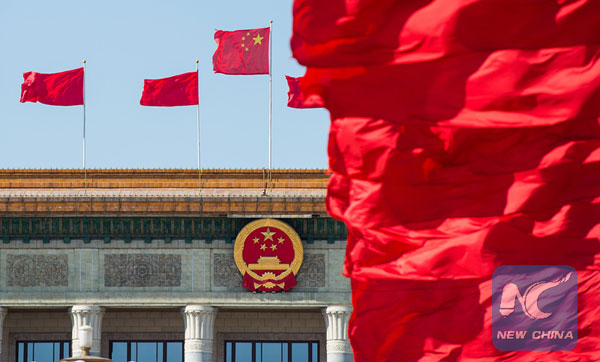
Red flags on the Tian'anmen Square and atop the Great Hall of the People in Beijing. [Photo/Xinhua] |
Comradeship means sharing the same principles and political goals; it also means all comrades are equal, and no comrade will be discriminated against because of his or her gender or other characteristics.
After the founding of the People's Republic of China in 1949, "comrade" became the most common term people used to address each other. Yet the term has almost disappeared from people's vocabulary over the past couple of decades.
Ordinary people have the right to address each other in any way they deem fit, but Party members have to use "comrade" when addressing each other. That applies even to the Party leadership with comrade Xi Jinping as its core.
The top leadership has decided to promote the use of the term "comrade" within the Party for several reasons. First, rampant individualism has been hurting common interests for quite some time. All Party members have the right to pursue their individual interests, but they should do so only after serving the common interest of the people, because Party members are supposed to have higher goals than ordinary citizens and also work to realize the goals of the Party. In this regard, by addressing each other as "comrades", the Party members can deepen their unity under the common flag of the Party.
And second, the sense of equality among Party members must be further promoted. Many Party members, especially government officials, tend to address each other by their official ranks, which promotes hierarchy, instead of equality, because people start attaching greater importance to their positions in the bureaucracy than those in the Party. By requiring Party members to address each other as "comrades", the leadership aims to strengthen their sense of equality and weaken their belief in hierarchy. That in turn will help different levels of Party organizations to become more efficient in decision-making, by better mobilizing the wisdom of all.
Of course, as an honorific term, "comrade" has its limits. The requirement of the top leadership and the practices of various levels of Party organizations have encouraged its use within the Party. In other words, it is a requirement of Party members, not of ordinary citizens.
This is in accordance with the basic national policy of reform and opening-up. Since the implementation of reform and opening-up in 1978, the top leadership has been attaching ample importance to market economy. And the Third Plenary Session of the 18th Communist Party of China Central Committee made it clear the market should play a decisive role in the allocation of resources.
Encouraging the use of the term "comrade" within the Party is also in line with the top leadership's move to strictly regulate the Party. Ordinary citizens are free to pursue their individual interests as long as both the pursuit and the interests are legal and do not hurt public interests, but Party members must place public interests above individual interests. The top leadership's requirements from Party members are higher than those from ordinary residents. As such, by urging Party members to use "comrade" to address each other, the top leadership is taking stricter measures to regulate the Party and deepen the unity among Party members. However, the top leadership also has to issue detailed regulations and take specific measures to ensure the Party members fulfill those requirements and meet those goals.
Ji Naili
The author is a professor at the Zhou Enlai School of Governance, Nankai University.