'America First' trade rows about to begin
 |
| MA XUEJING/CHINA DAILY |
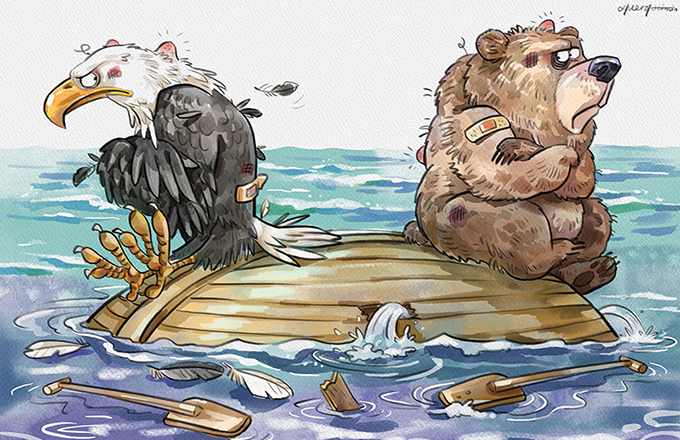
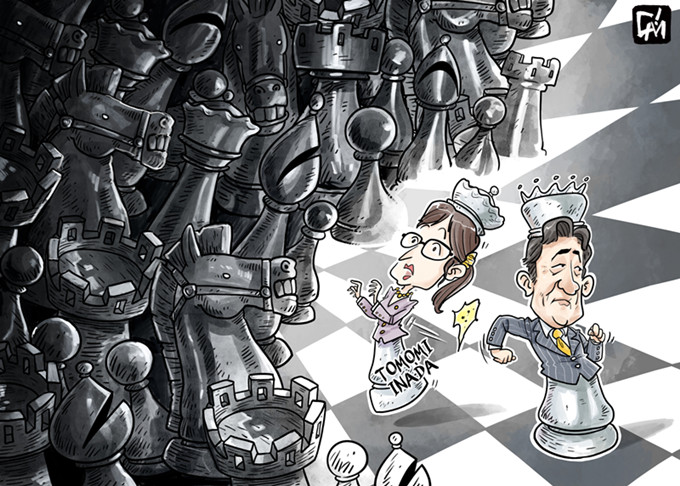
The first China-US Comprehensive Economic Dialogue in Washington concluded on July 19, without a joint news conferences, joint statement or new announcements on market access by the United States to China or vice-versa, prompting many to assume the CED has paved the way to a major trade conflict between the two countries.
But despite tough political rhetoric, economic realities do not seem to support such a view.
A more nuanced scenario is that, while the Donald Trump administration was willing to penalize the Sino-US economic dialogue over slow progress in deficit reduction and perhaps the Democratic People's Republic of Korea's geopolitics, it also wanted to use the CED as a "demonstration effect" in the impending North America Free Trade Agreement talks and trade reviews-to signal determination.
In fact, the shadows over the CED emerged a while ago. After Trump met with President Xi Jinping in early April, the two sides announced a 100-Day Action Plan to improve bilateral trade ties. Yet only two weeks later, Trump issued a presidential memorandum, directing Secretary of Commerce Wilbur Ross to investigate the effects of steel imports on the US' national security on the basis of the Trade Expansion Act of 1962.
After returning from his visit to France last month, Trump ramped up the heat. "They're dumping steel and destroying our steel industry," he said on the eve of the CED. "They've been doing it for decades, and I'm stopping it. There are two ways: quotas and tariffs. Maybe I'll do both."
While China's ambassador to the US Cui Tiankai warned Washington of "troubling developments" that could derail the bilateral relationship, Ross raised the heat by saying he would present Trump a range of options to restrict steel imports on national security grounds.
Significantly, steel imports as a national security threat was not presented only as a Sino-US issue but also as a multilateral challenge.
As steel imports suddenly became a "national security" issue for the US, Secretary of Defense James Mattis was dragged into the debacle. By mid-June, Europe's NATO leaders had already launched an extraordinary lobbying campaign against an anticipated US crackdown on steel imports, which, they said, would hit US allies more than China. Consequently, Mattis, not Commerce Secretary Ross, has been hearing the cases of apprehensive German and Dutch NATO leaders and passing on their concerns to the White House.
In the White House, the issue reignited the old divide between trade hawks-including Trump's trade and industrial policy head Peter Navarro; trade representative Robert Lighthizer; and trade advisor Dan DiMicco, who is former CEO of US steel giant Nucorwho are pushing for high import tariffs, and the more business-friendly former Goldman Sachs executives-Secretary of Treasury Steven Mnuchin and National Economic Council chief Gary Cohn-who argue for restraint.
Washington's European NATO allies do not buy the national security argument. Some EU leaders are even ready for retaliation if Trump decides to walk the talk.
On the other hand, the US' NAFTA partners have been monitoring the debacle closely. If the Trump administration plans to use steel as a national security threat, Canada and Mexico know full well the focus will also be on NAFTA rather than just China or Germany.
China produces almost half of the world's steel, but its US market share in steel is marginal-less than 2 percent. The largest steel exporters to the US include Washington's NAFTA partners Canada (almost 17 percent) and Mexico (about 9 percent), East Asian giants the Republic of Korea (12 percent) and Japan (nearly 7 percent), as well as Brazil, Turkey, Russia, Germany, Taiwan, Vietnam-and then the Chinese mainland.
So if Trump really is "hell-bent on imposing" major tariffs on steel, it is the US' NAFTA partners that will be the first to feel the heat. But if Trump moves further to imported aluminum, semiconductors, paper, household appliances, that's when China and other major exporters to the US will become targets as well.