Solid waste imports ban shows resolve to protect environment
 |
|
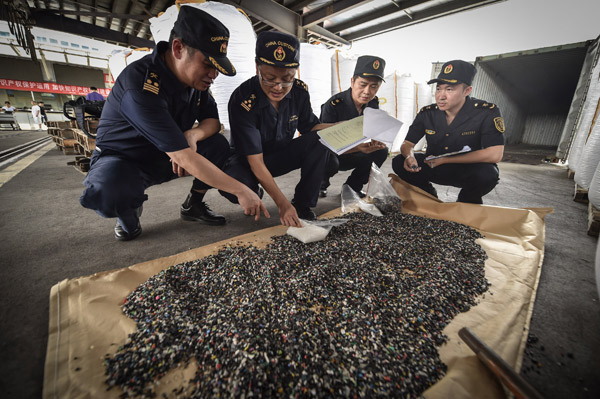
Employees of Shenzhen Customs display seized solid industrial waste which was smuggled into China. [Photo/Xinhua] |
IMPORTS OF ENVIRONMENTALLY HAZARDOUS SOLID WASTE will end before the end of the year, and imports of solid waste that can be replaced by domestic resources will end by 2019, the State Council, China's Cabinet, announced on Thursday. Beijing Youth Daily comments:
In fact, China notified the World Trade Organization 10 days earlier that it would take emergency measures to prohibit imports of 24 kinds of solid waste by the end of the year, including imports of household plastic waste, vanadium slag, unsorted waste paper and waste textile raw materials.
The United Nations Environment Programme issued the Basel Convention on the Control of Transboundary Movements of Hazardous Wastes and Their Disposal in 1989 to reduce the movements of hazardous waste, specifically from developed to less-developed countries, and ensure the environmentally sound management of waste as close as possible to its source.
China's decision is fully in line with the principle and content of the convention.
This move, widely praised at home, is testimony to the Chinese government's resolve to transform the country's development model and prioritize protection of the environment, ecology and traditional culture.
The processing of foreign waste has developed into a lucrative industry in some places. But there is a growing social consensus that the environmental costs far outweigh the revenues it creates. It is therefore natural for the authorities to weed out the harmful industry.
There is plenty of evidence proving that the pollutants and poisonous substances that are released in the processing of the imported waste can contaminate the environment and enter the food chain of animals and humans.
Admittedly, much of the waste, called "misplaced resources" by some, could be recycled and reused with the development of the necessary technology, but this lags far behind the speed at which the world produces these solid wastes.
Processing the waste and extracting the useable materials consume huge amounts of energy, which increases carbon emissions.
The ban provides China with a good opportunity to strengthen its sorting of waste and establish a system that encourage the waste producers, especially companies, to take part in waste disposal and recycling, so as to make better use of domestic waste and minimize the environmental damage it causes.