Traditionalist gives a huge culture shock
 |
|
?LUO JIE/CHINA DAILY |
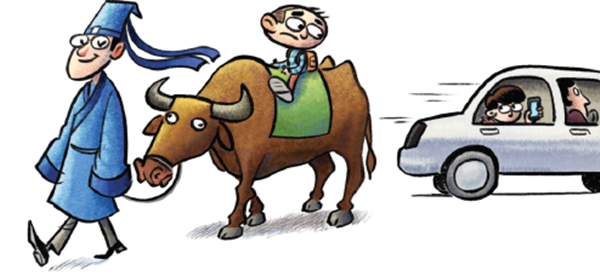
A person is free to ride a buffalo or donkey as long as he doesn't disrupt the flow of road traffic. But that person should realize this is not the 18th or 19th century, and the din created by traffic on city roads today can easily frighten buffalos, donkeys and other beats of burden. And if he still insists on riding buffalos in order to preserve "traditional Chinese culture", he is simply wrong.
From the latter part of the Qing Dynasty (1644-1911) to the mid-20th century, when foreign cultures and modern science and technology entered China in a big way, dozens of scholars of "traditional Chinese culture" realized the importance and value of Western products such as coffee, bread, bicycles and automobiles, instead of rejecting them.
In the latter half of the Tang Dynasty (618-907), the other period when the inflow of foreign cultures worried cultural conservatives, some military commanders imitated the combat tactics adopted by generals during the Spring and Autumn Period (770-476 BC) and used bullock-carts to fight with the rebels. The result: the Tang army suffered a disastrous defeat.
Three years ago, a 33-year-old man in Guangnan, Yunnan province, tried to cure his 6-year-old daughter of thalassemia by making her sit on a wooden shelf while he burned some herbs he had collected from the mountains at the base of the shelf. What he actually ended up doing is causing more pain to his daughter, who had to close her eyes and cover her mouth and nose to escape the smoke. The man claimed to have learned the treatment from the Compendium of Materia Medica, a herbal medicine book compiled about 500 years ago.
The "buffalo rider" in Chengdu may not cause his son physical pain. But he and other parents (and educational institutions) infatuated with traditional Chinese culture must carefully design teaching methods to inculcate traditional Chinese cultural values in the young. Normally, such parents and institutions emphasize rote learning-forcing the children to keep on reciting some ancient Chinese texts until they memorize them. It doesn't matter to them that the texts are written in classical Chinese, which is rarely used nowadays.
Some institutions even ask their students to wear traditional Chinese clothes and practice ancient rituals, some of which stifle children's creative faculties, to show off their love for Chinese culture.
History shows that this so-called classical method of teaching, which became increasingly rigid after the Ming Dynasty (1368-1644), is not at all conducive to cultivating innovative and critical thinking among students, which was an important reason why China lagged behind the West in science and technology.
Traditional Chinese culture is indeed a heritage, because it comprises values and outlooks that will remain relevant forever. But that does not mean people can cultivate those values and acquire those outlooks by just reading ancient books and practicing rituals.
More important, Chinese culture is one of the most inclusive in the world, because it has never stopped absorbing the good qualities of foreign cultures. This inclusiveness has made Chinese culture sustainable. And by resisting new ideas and objects, we can only cause the slow demise of this valuable culture.
Riding a buffalo might be an interesting experience for the boy in Chengdu. Hopefully, he will also develop an interest to know on his own what traditional Chinese culture is really about, instead of blindly believing in what his father says.
The author is a writer with China Daily. liyang@chinadaily.com.cn