Polls put May in awkward position to negotiate Brexit
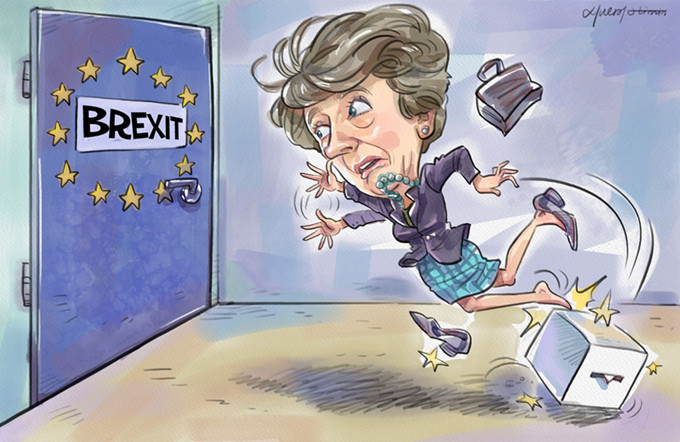
The media in the United Kingdom looked to horror movies for inspiration to describe British Prime Minister Theresa May's shock setback in the June 8 election, but by mid-week they had recycled the theme to suggest she might yet rise from the grave in which many thought she had been prematurely buried.
To recap: May's ruling Conservative Party did win the snap poll, but her failure to secure absolute majority in the House of Commons shattered her claim to be the only "strong and stable" leader to undertake Brexit negotiations with the European Union.
By contritely apologizing to her members of parliament for the mess she had landed them in, May has perhaps bought herself some time. A much-criticized tactical alliance with Northern Ireland's ultra-conservative Democratic Unionist Party could give her the necessary votes to get a stripped-down manifesto through parliament.
A combination of pragmatism and ambition on the part of the Conservatives is likely to leave May in place, at least for the time being. But she is seriously weakened as she prepares to launch negotiations with the EU, as early as next week, on the terms of the UK's departure from the European bloc.
That has given some comfort to pro-EU members of all parties who hope that the government would now be obliged to aim for a so-called "soft" Brexit that would leave many of the benefits of EU membership in place. May wanted to contest the election on the Brexit issue, although the opposition Labour Party skillfully shifted the emphasis to the Conservatives' record on austerity, welfare and the state health service.
Nevertheless, there are indications that Brexit did play a central role in the result. Young people, shocked into action by the results of last year's referendum in which many of them had not bothered to vote, turned out in large numbers for Labour in revenge for Brexit. Labour also did well in those areas which had seen a large "remain" vote in 2016.
The irony is that Labour leader Jeremy Corbyn is scarcely an EU enthusiast, having run a lackluster campaign in 2016 that left "remainers" suspecting he was a secret "Brexiteer".
However, a majority of Labour MPs support a "soft" Brexit, as does a minority of the Conservative Party. Even May's potential allies in the pro-Brexit DUP want to retain some of the free trade benefits of EU membership after Britain leaves the bloc. That means a majority of the House of Commons opposes May's stance, as spelled out in the election campaign-that no deal with the EU is preferable to what she would regard as a bad deal.
The question is whether this diverse alliance can rally the parliamentary clout to influence the course of Brexit negotiations.
The Conservative Party, which has been periodically torn apart over the past four decades by a civil war fought on the battleground of the EU, is known for its sharp survival instincts. Even if a majority of its members favor a "soft" Brexit, staying in power will come first in the party's calculations.
On the other hand, an EU invigorated by the election of French President Emmanuel Macron and the prospect of Germany's Angela Merkel being re-elected this autumn, is viewing Britain's political antics with increasing irritation. It is now a year since the British voted, by a narrow margin, to quit the EU and talks, which have a two-year deadline for completion, are only now about to begin.
The Europeans, previously shocked and disappointed by Britain's decision to quit the EU, may now be thinking "good riddance". The EU's chief negotiator, Michel Barnier, warned this week that the UK risks quitting the EU in March 2019 with no deal in place if it does not appoint a stable and accountable negotiating team to sit down for talks "very quickly".
In a withering put-down of Britain's current political confusion, Barnier commented: "I can't negotiate with myself."
The author is a senior editorial consultant for China Daily, Europe. harveymorris.gmail.com