Unisex public toilets a pioneering project
 |
|
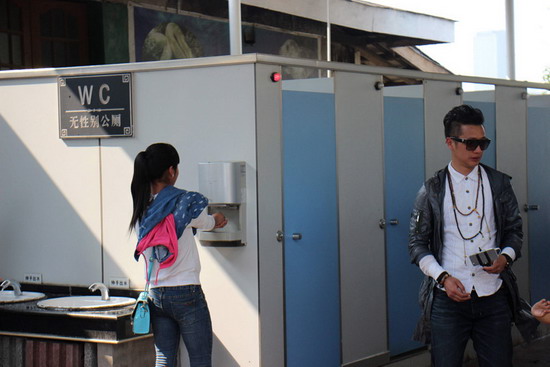
A unisex public washroom is seen in Chongqing on April 15, 2015. [Photo: CFP] |
China has a lot of amazing tourist attractions, but both domestic and foreign tourists usually have unpleasant experience or impressions with its public toilets-"inadequate, dirty and chaotic".
In 2015, the China National Tourism Administration launched a three-year "Tourism Toilet Revolution" across the country. In February this year, the NTA announced that all 5A scenic spots will build gender-neutral restrooms, and has plans to build 604 unisex toilets across the country.
Unisex public toilets can be used by everyone, regardless of their gender. Alternatively, they are called gender-inclusive, gender-neutral or all-gender toilets, but in fact they have slightly different toilet facilities.
Although unisex public toilets have become more common around the world, they remain highly controversial, even in the West. According to a survey by YouGov, unisex public toilets are more acceptable to men. British women are most anti-unisex public toilets, with 56 percent saying they would not feel comfortable using them, compared with 47 percent of women in the United States and 46 percent in France.
Last November, the introduction of unisex toilets in a London primary school sparked outrage among about 700 parents, who were worried that the change would make sexual assaults more common. However, the school's head teacher welcomed the change, saying the full-height unisex toilets created a safe space where pupils show respect toward each other and feel respected.
On Feb 22, US President Donald Trump scrapped the federal guidelines issued by his predecessor Barack Obama in 2016, which allow transgender students to use toilets or locker rooms that they identified with.
Canada has been a pioneer in advocating all-gender restrooms. In April 2014, Vancouver became the first municipality to impose compulsory requirements on public buildings to install unisex toilets.
While the issue of unisex toilets has been mainly raised as a gender-equity and human-rights cause in the West, China has a different focus largely from the infrastructure perspective. According to the NTA, a gender-neutral public toilet can simply be viewed as a "family toilet", which specifically targets children, the elderly, disabled people, and anyone else who may require the assistance from other family members.
In recent years, many people in China have said that more women's toilets should be built to help reduce the queuing time for women. In the short run, unisex public toilets can be an additional and helpful option.
In November 2016, Shanghai opened its first unisex public toilet in Pudong district, and the second one was opened in Huangpu district earlier this year. The primary purpose is to reduce the queuing time for women, and the goal has been significantly achieved, although public reactions remain mixed.
So far, the majority of the users of the two unisex toilets have been male. While youths have been faster to accept the new idea, most users still feel awkward to have men and women both in one public toilet. Obviously, the main challenge is to change people's mindset.
Do unisex public toilets face higher safety risks? In the West, opponents usually say such toilets raise the risk of women and children being assaulted by "transwomen", but there is no credible evidence to support this claim.
However, a US research shows that certain people do feel threatened using toilets that do not adhere to their gender identity. It seems more like a perceived rather than real danger. Based on the track record of Shanghai's first unisex public toilet, safety is not a big issue, because the toilet is open daily only from 5 am to 9 pm and monitored by designated staff.
The more urgent task is to raise public awareness. Recently, it was reported that very few visitors used the unisex toilets in Beijing Zoo, because many people were unaware of such facilities.
As a pilot project, it is not unusual for unisex public toilets to invite questions or even criticisms. But it is not difficult to convert them back to gender-specific toilets if such experiment fails. At least, such pioneering and innovative spirit should be welcome.
The author is the founder and CEO of ESGuru, a Singapore-based consultancy firm specializing in environmental, social and governance issues.