Managing the military according to rule of law
 |
|
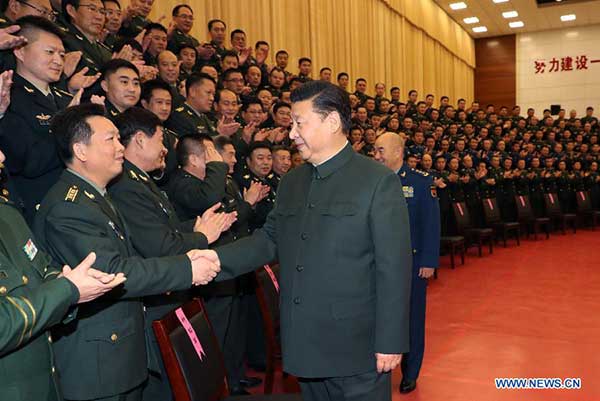
Chinese President Xi Jinping (R, front), also general secretary of the Communist Party of China (CPC) Central Committee and chairman of the Central Military Commission, shakes hands with senior military officers stationed in Zhangjiakou city, North China's Hebei province, Jan 23, 2017.[Photo/Xinhua] |
A decree signed by President Xi Jinping, who is also chairman of the Central Military Commission, took effect recently, laying out rules for the formulation military laws and regulations, as well as the procedure for drafting standard documents. The decree is aimed at implementing a regulation governing rulemaking in military affairs and standardizing the formulation of military laws and regulations.
The move is expected to strengthen military laws by making clear the legislative responsibilities of all parties concerned. According to the latest regulation, the CMC, for example, has the right to formulate military laws and regulations, while the theater commands can just draw up regulations. In terms of effect, it makes clear the regulations promulgated by the CMC override those passed by other military organs.
Besides, all military laws, normative documents, and regulations are now subject to the new regulation on military legislation. Previously, the implementation of normative documents was exempt from supervision at the central level, which could lead to inefficient, even counterproductive, legislative work.
On legislation, the regulation stresses the absolute leadership of the Communist Party of China over the military. In particular, the drafting, submission, modification and issuance stages all are subject to scrutiny by Party committees at all levels. It is also in line with the Legislation Law, which was revised in 2015 to broaden public participation in legislation and streamline legislative consultation, especially to meet the need for further civil-military integration.
Ostensibly, military laws and regulations apply only to the military. But their implementation can also affect ordinary citizens, whose coordination in issues ranging from military conscription and national defense education to protection of military facilities and arrangements for retired servicemen, matters a great deal. In other words, those formulating military laws and regulations also have to take into account the activities of citizens, organizations and enterprises.
Managing defense affairs in accordance with the rule of law depends on stronger national defense laws as well as their implementation, and a functioning accountability mechanism. Since national defense is not about just military buildup, but also to serve the people, the connection between the military and civilians needs to be strengthened to fulfill the due purposes.
The author is an associate professor at Northwest University of Political Science and Law.