A maritime Silk Road to peaceful seas
 |
|
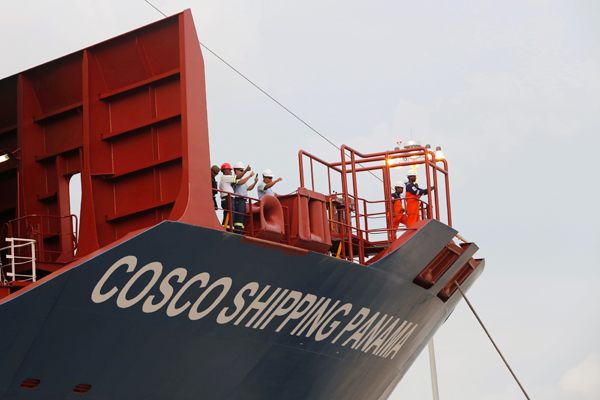
Workers are seen on a Chinese COSCO container vessel, as it arrives to Cocoli locks after crossing the Panama Canal to the Pacific side, during its first ceremonial transit of the new Panama Canal expansion project in Cocoli on the outskirts of Panama City, Panama June 26, 2016. [Photo/Agencies] |
Westerners may better remember the ancient terrestrial Silk Road, but a magnificent Chinese fleet, led by legendary explorer Zheng He reached East Africa as early as the 15th century. Six centuries later China and its companies are building up the 21st Century Maritime Silk Road (as part of the Belt and Road Initiative). With ports, railroads and related economic activities, the maritime route will complement the land infrastructure along the Silk Road Economic Belt, which will connect Asia with Europe and Africa. What are the maritime route's main advantages and characteristics?
First, it can boost trade and economic activity in one of the world's most dynamic and at the same time most problematic regions. Chinese companies are engaged in a string of ports from Southeast Asia to Venice, including Colombo in Sri Lanka, Karachi and Gwadar in Pakistan, Port Said in Egypt, Kumport in Turkey, and Piraeus in Greece.
Ports bolster trade, industries and businesses in general. Colombo's City Port is a major project at India's gates, with developments both in trade and finance (including an International Financial Center). Port Said and Kumport have crucial strategic importance. Piraeus in Athens, on the other hand, had a throughput of about 1.5 million 20-foot equivalent unit (TEU) before China Ocean Shipping Company gradually took it over in the 2010s. Now its throughput is about 3.5 million TEU, which is in sharp contrast to Greece's financial figures.
East Africa and South Asia are other world regions with terrific growth potential. Chinese companies have recently invested in the Port of Djibouti, a gateway to East Africa and the Middle East, and in a major railroad linking it to Addis Ababa, the capital of Ethiopia, which is rising from poverty also thanks to massive Chinese investments in infrastructure and hydropower. Though better off, Kenya and Tanzania as sources of minerals will also benefit from China-built infrastructure.
Pakistan's case is even more interesting. Pakistan can benefit from the China-Pakistan Economic Corridor, a reportedly $46 billion giant project. Pakistan is geographically crucial because it links the terrestrial Belt with the maritime Road, China and Central Asia with the Middle East.
Pakistan's physical infrastructure is largely outdated, and recurrent power outages rip off an estimated 2 to 2.5 percent of its GDP every year. China's engagement with ports, motorways, railroads and energy facilities is therefore more than welcome in Pakistan; in many ways it will be a game changer for the whole of South Asia.
Energy is then a crucial issue, not only for Islamabad. By investing in the CPEC, Beijing can cut the time and costs of shipping resources via the Malacca Strait.
The 21st Century Maritime Silk Road is relevant to financial issues, too. China will have to develop a large stock exchange to support State activity with funds raised in capital markets. Shenzhen, Shanghai, and the latter's link to the Hong Kong Special Administrative Region already provide an excellent starting point. Something akin to an East Asian "Wall Street" would permit China to compete with the US financially as well. In this sense, China's stock exchanges may have to invest in other stock markets along the maritime Silk Road: maybe global and cosmopolitan Singapore? Or Kuala Lumpur? Jakarta? Or Sydney, where some large Chinese companies are already listed?
A Chinese consortium of exchanges recently acquired a 40 percent share in the Pakistan Stock Exchange, (which itself is a merger of three bourses-Karachi, Lahore and Islamabad), a move which may greatly boost Pakistan's economic growth and China's infrastructure investment in South Asia. This can be compared with the recent agreement between the Bank of China and the Budapest Stock Exchange-a bit further away from the Mediterranean but still linked to the Belt and Road Initiative.
Hungary's shift away (and against) the European Union also exposes the old continent's divisions and difficulties. The combination of a maritime and a land-based project could bring benefits to both Northern and Southern Europe, apart from bridging the gap between the West and East.
Ernesto Gallo is a tutor of business, law and social sciences at Kaplan International College, London, and Giovanni Biava is an energy and gas consultant at Exelen group.
- List of Deliverables of the Belt and Road Forum for International Cooperation
- Joint Communique of the leaders roundtable of the Belt and Road Forum for International Cooperation
- How the Belt and Road could change the 21st century
- Xi: China to host 2nd Belt and Road forum in 2019
- Chinese technologies connect Belt and Road
- Xi elaborates on inspiration behind Belt and Road Initiative
- New book highlights success stories of Belt and Road lands
- Belt and Road aim to boost globalization