Space program signals wider Sino-European ties
 |
|
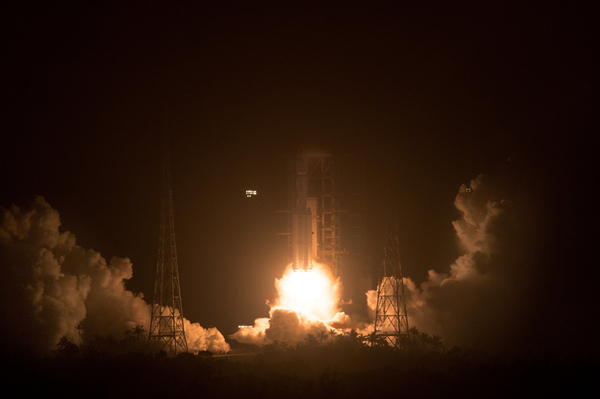
China launched its first cargo spacecraft at 7:41 pm on April 20 on a mission to test refueling technology and perform scientific experiments. Tianzhou 1, the nation's biggest, heaviest spacecraft, blasted off from the Wenchang Space Launch Center in Hainan province. [Photo by Ju Zhenhua / Xinhua] |
The talks on the proposed cooperation were first disclosed in April by Tian Yulong, head of the China National Space Administration, and subsequently confirmed by Pal Hvistendahl, a spokesman for the European Space Agency.
The "Moon Village" concept, which the ESA also sees as an opportunity to develop space tourism and lunar mining, is regarded as just one area of potential European-Chinese space cooperation. The Chinese space agency plans to launch a mission to collect samples from the moon by the end of this year and conduct its first mission to the far side of the moon next year. The ESA hopes to take part in analyzing those samples.
"Space has changed since the space race of the 1960s," Hvistendahl said. "We recognize that to explore space for peaceful purposes, we do need international cooperation."
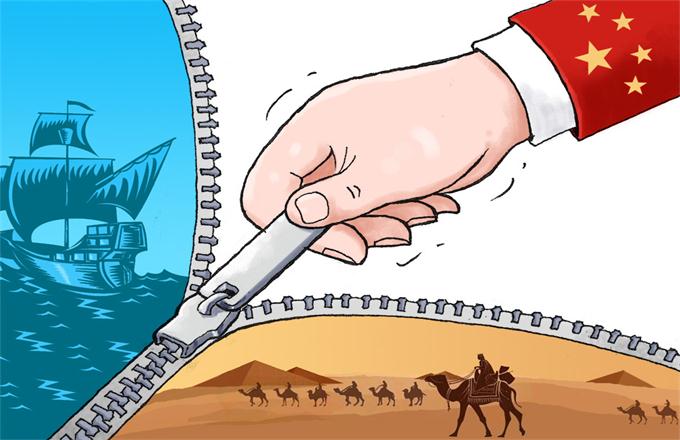
Back on Earth, closer ties between Europe and China are evident in several other areas, including the development of a rail freight network. In January, London became the 15th European city to be served by direct rail service from China as part of the Belt and Road Initiative.
The growing transportation links reflect the importance of China as Europe's fastest-growing export market. The closer ties are for the most part focused on the economic front, with European countries competing in areas that range from encouraging Chinese inward investment to tapping further into the burgeoning Chinese tourism market.
However, the election of US President Donald Trump on a protectionist and more inward-looking platform has prompted the Europeans to ponder what some experts see as a broader pivot to China.
Even before Trump's election, the European Union adopted a new strategy on relations with China to the end of the decade that outlined the major benefits to Europe of closer ties in terms of jobs and growth. The strategy unveiled last summer went beyond trade issues, however, to encompass cooperation on major global political issues, including climate change. "We can and must do more to connect the European Union and China," Federica Mogherini, the EU's foreign policy chief, said then.
This European open-handedness was unsurprisingly twinned with the usual EU warnings about unfair competition and Chinese industrial capacity, particularly in the steel sector. At around the same time, Chinese Premier Li Keqiang reminded an EU-China summit in Beijing that both sides played major roles in maintaining world peace and development. China and Europe should therefore cooperate closely by sending positive signals to a world facing complex political and economic developments.
The political outlook in the US, where the new president tends toward protectionism and climate change skepticism, has pushed China and Europe into a joint leadership role on at least two vital issues.
At the China-EU strategic dialogue in Brussels last month, Li urged the EU to promote globalization and free trade, while Mogherini said both sides needed to support the World Trade Organization "to avoid any protectionist policy or attitude".
Moreover, with the prospect of the US pulling out of the Paris Agreement on climate change-Trump has promised to make his "big decision" later this month-it will be up to China and Europe to take the lead in spurring global action on carbon emissions.
Nowhere are differing attitudes to cooperation more apparent than in the "Moon Village" concept. Even the administration of former US president Barack Obama declined to partner with the Europeans on the project, while Trump's main space initiative has been to talk of speeding up unilateral plans for a US mission to Mars.
And, as European and Chinese experts prepare to sit down and discuss cooperation on the project, the US space industry has been pressuring Washington to tighten rules on commercial space activity, with scary warnings of China taking over the galaxy.
The author is a senior media consultant for China Daily. harvey.morris@gmail.com
- New cooperation agreement to boost Sino-European trade
- Sino-European ties add to global system
- Stable business rules crucial to enhance trust in Sino-European co-op
- Chinese top business leaders see innovation as key pillar of Sino-European cooperation
- Sino-European Men's Basketball Championship to begin