Reprieve or reform in European Union
 |
|
MA XUEJING/CHINA DAILY |
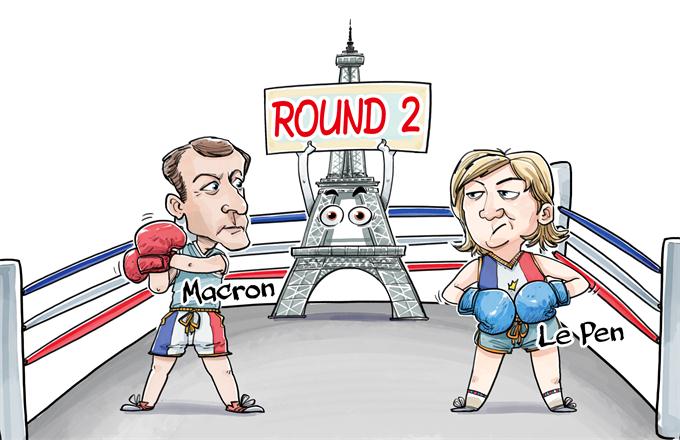
The first round of the French election turned out much as expected: the centrist Emmanuel Macron finished first, with 24 percent of the vote, rather narrowly beating the right-wing National Front's Marine Le Pen, who won 21.3 percent. Barring a political accident of the type that befell the former frontrunner, conservative Fran?ois Fillon, Macron will almost certainly win the second-round runoff against Le Pen on May 7. The European Union seems safe-for now.
But this is no time for complacency. Unless Europe addresses flaws in growth patterns and pursues urgent reforms, the longer-term risks to its survival will almost certainly continue to mount.
As has often been noted, the French election, like other key votes over the past year, represents a rejection of establishment political parties. But unlike last year's votes for Brexit in the United Kingdom and Donald Trump in the United States, which were driven by middle-class, middle-aged voters, in France, the young led the way in rejecting the establishment.
This trend is not exclusive to France. In Italy, the anti-establishment, Euroskeptic Five Star Movement has surpassed the center-left Democratic Party in recent polls, with the young comprising a significant share of that support. And the fact that parties and candidates that reject the status quo are gaining ground, particularly among young people, reflects profound political polarization, which generates governance challenges that could impede reform.
Yet reform is precisely what is needed to address these trends, which reflect fundamental problems with today's prevailing growth patterns. In France, Italy and Spain, growth is too slow, unemployment is high, and youth unemployment is even higher. In France, the youth-unemployment rate is about 24 percent, and trending downward only slowly. The youth unemployment rate in Italy stands around 35 percent and exceeds 40 percent in Spain.
These are countries with substantial social-security systems. But those systems protect labor-market incumbents much more than new entrants. And the reforms that have been implemented, in order to ease entry into work, are not sufficient in the context of weak overall growth.
Without deeper reform, the demographic arithmetic suggests the disenfranchised and anti-establishment share of the population may grow (unless today's young people change their stripes as they age). The question is whether this trend will lead to a genuine disruption of the status quo or merely to political polarization that weakens government effectiveness.
The solution to European economies' woes seems clear: a set of reforms that encourages more vigorous and much more inclusive growth patterns. After all, while globalization and technology lead to job displacement, sufficient growth can ensure that overall employment is sustained. To that end, reforms are needed at both the national and EU levels.
While each EU country has its own specific features, some common reform imperatives stand out. In particular, all countries need to reduce structural rigidity, which deters investment and hampers growth. To boost flexibility, social-security systems have to be largely disconnected from specific jobs, companies and sectors, and rebuilt around individuals and families, income, and human capital.
The remainder of the domestic reform agenda is complex, but its goal is simple: enhance private-sector investment. Under this heading are items like regulatory reform, anti-corruption measures and public-sector investment, especially in education and research.
At the EU level, the most important recent development is the weakening of the euro since mid-2014. This has caused the eurozone to run a substantial surplus and helped to restore some competitiveness in the tradable sectors in France, Spain and Italy. In all three countries, tourism is an important sector for employment and the balance of payments, and expenditures have been rising when measured in euros.
Also needed is EU-level action on immigration, which has emerged as a major economic and political issue. Faced with inflows of huge numbers of refugees from the Middle East and Africa, the EU may need to modify the free movement of people for a period of time.
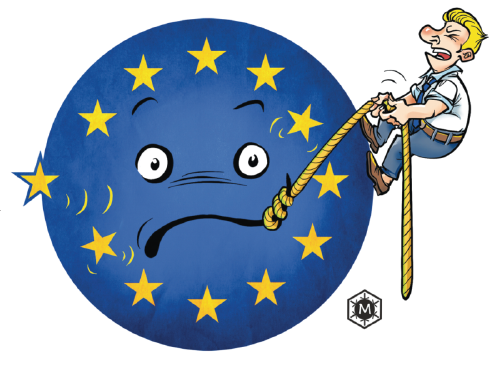
After Germany, France is the most important country in the eurozone. If a Macron victory is treated as an opportunity to pursue aggressive reforms targeted at boosting growth and employment, the French election may amount to an important turning point for Europe. If, however, it is treated as a validation of the status quo, it will produce only a short reprieve for a besieged EU.
The author, a Nobel laureate in economics, is a professor of Economics at New York University's Stern School of Business and senior fellow at the Hoover Institution.