London attack raises some vital questions
 |
|
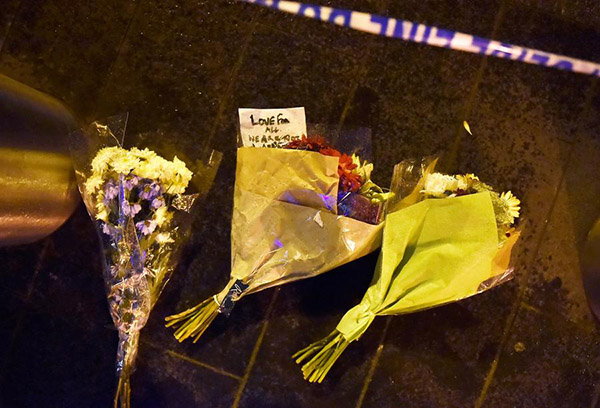
Flowers are laid at the scene after an attack on Westminster Bridge in London, Britain, March 22, 2017. [Photo/Agencies] |
The London attack on March 22 in which five people, including the attacker and a policeman, were killed and 40 injured is another potent warning against terrorism.
The United Kingdom has been tightening its security measures after the 2005 terrorist attack in London that claimed more than 50 lives. The measures include sharing information with other countries, strengthening the police force, as well as providing professional training to counter-terrorism forces. But, as the March 22 attack showed, it is still difficult even for a country with the tightest security to prevent a terrorist attack.
Last week's London attack also showed new trends in terrorism, such as "lone wolf" attacks. These "lone wolves" are sometimes helped by one or two residents to launch attacks on unsuspecting innocent people. The number of lone wolf attacks has been rising since 2000. In May 2013, two terrorists killed a soldier in London; in March this year, a man, later identified as an extremist, was shot dead while trying to snatch the weapon of a female solider at Orly Airport in France. All those were so-called lone-wolf attacks.
With more countries imposing greater restrictions on possession of guns and explosives, terrorists are using easy-to-get tools to launch attacks. Driving vehicles into crowds and going on stabbing sprees have become their preferred methods to spread panic among the people.
Back in June 2007, terrorists tried to attack Glasgow International Airport with an SUV loaded with gas cannisters; in December last year, a terrorist drove a truck into Christmas shoppers in Berlin, killing 12 people and injuring over 50; five months before that, another man drove a truck into crowds celebrating Bastille Day on the Nice promenade, killing 86 people and leaving 434 injured. Even in the last week's London attack, the terrorist used a vehicle to attack pedestrians on Westminster Bridge meters away from the British parliament building.
Another striking feature of the recent terrorist attacks is the targets: landmark buildings where large numbers of people assemble. Westminster Palace in London is the latest example. Terrorists target such structures because they believe an attack on any one of them will deal a psychological blow to the government and the people.
In November 2015, terrorists struck outside the Stade de France and fired indiscriminately inside the Bataclan Theatre in Paris, both landmark structures. Some terrorists even attacked the Louvre Museum, another Paris landmark, on Feb 2 this year.
The "war on terror" has taught us that although it is relatively easy to physically eliminate terrorists it is hard to spiritually root out terrorism. Take the UK for example. After World War II, it welcomed hundreds of thousands of migrants from other countries due to shortage of labor. But despite spending decades in the UK, the children and grandchildren of many of those migrants are still poor compared with "native" residents. And even though British society is quite open and its government has adopted policies to suit all ethnic and religious groups, many among the migrant communities still find it difficult to melt into the British milieu.
Since many of the youths in the migrant communities do not identify themselves with British society, they do not consider the UK their homeland. And with easy dissemination of information on the internet, they may fall prey to terrorist propaganda.
The solution therefore lies in not only more strictly controlling the borders, but also helping the migrants and their children and grandchildren to improve their economic conditions and identify themselves with their countries of residence.
But this is easier said than done. So the UK and European leaderships need to find a way to balance the interests of migrants and "native" residents and build inclusive societies. Only in this way can terrorism be truly defeated.
The author is a professor at the International Politics Department of the University of International Relations in Beijing.