Peninsula issue requires deft handling
 |
|
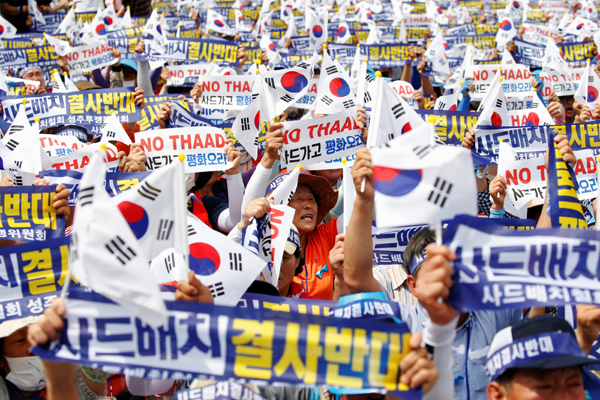
File photo shows Seoungju residents chant slogans during a protest against the government's decision on deploying a US THAAD anti-missile defense unit in Seongju, in Seoul, South Korea, July 21, 2016. The banner reads "Desperately oppose deploying THAAD". [Photo/Agencies] |
The premier's remarks come at a time when there is no sign of reconciliation among the United States, the Republic of Korea and the Democratic People's Republic of Korea. That Washington and Seoul have given up efforts to hold talks with Pyongyang is another indication that the Korean Peninsula may be heading toward an uncertain future.
Believing that efforts to invite the DPRK for talks might send the wrong message that the relevant parties condone its nuclear ambitions, the US is inclined to shut the door on diplomatic maneuvers. The US does not want to break the nuclear dilemma either if it means paying a high cost.
Washington is wary of the denuclearization efforts made by China and Russia, which it sees as a threat to its regional alliance. Unlike his predecessor Barack Obama, who put extra pressure on Pyongyang without provoking a military clash, US President Donald Trump could abandon the "strategic patience" and consider harsher measures.
Moreover, since Lee Myung-bak's election as ROK president in 2008, Seoul has become increasingly assertive in its pursuit of reunification with the DPRK. His successor Park Geun-hye, who was removed from office after impeachment last week, ordered the "temporary" closure of the Kaesong Industrial Complex, the only collaborative economic project between Seoul and Pyongyang, in February 2016, and resumed blaring propaganda messages from loudspeakers across the border and calling for a halt to inter-Korean communications.
Pyongyang, on the other hand, intensified its efforts to develop nuclear weapons and long-range missiles in the hope that the international community will be compelled to accept it as a nuclear power.
But none of the three countries are likely to get their end of the "bargain".
Washington's pressure-driven tactics couldn't move Pyongyang from its nuclear course, draining the patience of Japan and the ROK. Although the ROK lays emphasis on reunification, its hard-line approach has failed to weaken the DPRK's nuclear ambitions, making its mission even more uncertain. And the DPRK can never match the US' nuclear capability. In other words, Pyongyang's nuclear-minded strategy can neither keep Washington out of the peninsula affairs nor make the region safer. Isolation from the international community is no guarantee of security either.
The most effective approach, as China's Foreign Minister Wang Yi said last week, can only be negotiation. China wants the DPRK to abandon its nuclear and missile programs. Correspondingly, it wants the US and the ROK to halt their large-scale military exercises. Also needed is a dual-track approach to restore peace on the Korean Peninsula and replace the 1953 armistice agreement with a permanent peace pact.
We must keep in mind the complexity of the DPRK nuclear issue, which is related to the reunification of the DPRK and the ROK, a Washington-Pyongyang rapprochement, and geopolitical balance among China, Russia, and the US in Northeast Asia. So the resolution of the peninsula issue will take time and encounter speed bumps even if all the concerned parties return to the negotiation table.
Besides, leadership changes in the US and the ROK could mean changes and even about-turns in the two countries' DPRK policy. Therefore, all parties should tread carefully and stay on the right track even though they hit unexpected speed bumps, if they really want to resolve the Korean Peninsula nuclear issue.
The author is an associate researcher at the China Institutes of Contemporary International Relations.