Fairer distribution of education resources always a pressing issue
 |
|
Premier Li Keqiang talks with Xinjiang students at Dalian No 20 Senior High School in Liaoning province on Monday, one day before Teachers' Day. ZOU HONG / CHINA DAILY |
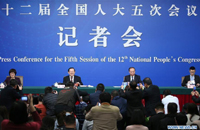
MINISTER OF EDUCATION CHEN BAOSHENG answered questions from the media at a news conference during the fifth plenary session of the 12th National People's Congress, China's top legislature, on Sunday. A primary concern was how to better balance education resources among different provinces and regions, as well as between urban and rural areas. Southern Metropolis Daily comments:
Several media outlets asked questions about education equality. Xinhua News Agency asked about the difficulties that poor, rural primary schools face in recruiting teachers, while China Education TV mentioned the village in Liangshan Yi autonomous prefecture, Southwest China's Sichuan province, that has been in the news recently because the children there have to climb down and up a ladder to scale the cliff face when they travel to and from their school at the bottom of the cliff.
Combining these questions with the others, we can conclude that fair distribution of education resources is a primary concern of the public and the major media outlets. While some developed provinces and regions are so rich that they have extended free education to 15 years, many poor regions find it hard to sustain the compulsory nine years of free education.
Last July, the State Council, China's Cabinet, issued a guiding document that listed 10 measures, including further coordinating education resources between urban and rural regions, to help improve mandatory education in rural regions.
The central government has been making efforts to more fairly distribute education resources among different provinces and regions. Now it is the turn of local governments to improve the most basic public education products for residents.
In that process, local governments should better mobilize private capital and other social resources, instead of fighting alone.
Besides, many entrepreneurs have been investing in private primary and secondary schools, and they are now running smoothly in rural regions. If these private schools can prosper more people will be encouraged to invest in rural education.