Lower defence budget reflects confidence
 |
|
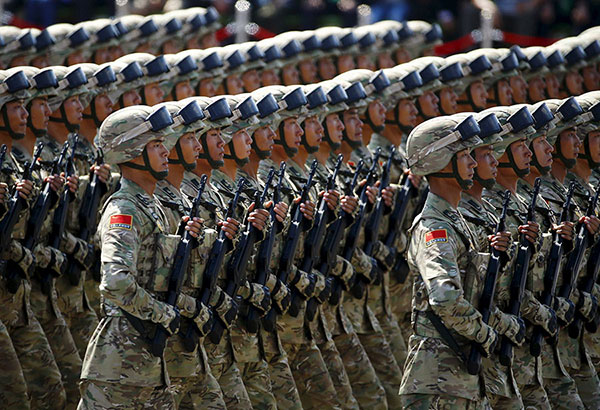
Soldiers of China's People's Liberation Army (PLA) march during the military parade marking the 70th anniversary of the victory of the War of Resistance against Japanese Aggression and the World Anti-Fascist War, in Beijing, Sept 3, 2015. [Photo/Agencies] |
If China's 7.6 percent military budget increase last year, the lowest since 2011, raised eyebrows, then the lower increase of only 7 percent announced for 2017 raised a question: Will such a low defence budget become the new normal in years to come?
The answer is probably yes. China's economy has slowed. Premier Li Keqiang anticipates GDP growth of 6.5 percent this year. For the People's Liberation Army, defence spending has to go in tandem with national economic development. This is a principle that has been upheld since former leader Deng Xiaoping told the PLA in 1985, "The real modernization of the weaponry of the military will only be possible when the national economy has laid a sound basis for it."
Will a 7 percent budget increase affect the PLA's capacity building? Yes, but in a limited way. Thanks to the PLA's strenuous modernization efforts and China's sustained investment in its defense industry over the decades, the PLA has been able to advance by leaps and bounds. The ongoing military reform, the most profound in the history of the PLA in terms of vision and audacity, will bring revolutionary changes to the PLA and make it leaner and stronger. Simply put, the PLA now can afford to have a lower defence budget.
And, if defence expenditure is an indicator of a country's security assessment, then China's lowest ever budget speaks volumes about its confidence in the world order and in the regional situation. Yes, there are many global problems ranging from the nuclear issue on the Korean Peninsula to the rise of the Islamic State terrorist group, the exodus of refugees and rising nationalism and populism in Europe and the United States, but isn't history full of similar problems in different clothing? And isn't the world today much safer than when it was always on the brink of nuclear conflict during the Cold War?
China is now closer to center stage in world affairs and what China thinks matters all the more to the rest of the world. If China believes its security environment has worsened to the degree it has to largely increase its military spending, it will be a nightmare for its neighbors. If China believes the US has taken China as enemy, then the US is China's enemy.
But in the various crises that have occurred in the past, such as Taiwan ex-leader Chen Shui-bian's call for a referendum on Taiwan "independence", NATO's bombing of the Chinese Embassy in the former Yugoslavia, the collision between Chinese and US aircraft in China's exclusive economic zone, China has continually exercised restraint and, more importantly, it hasn't changed its optimistic conclusion that although the world is far from peaceful, peace and development are still the major trends of the times.
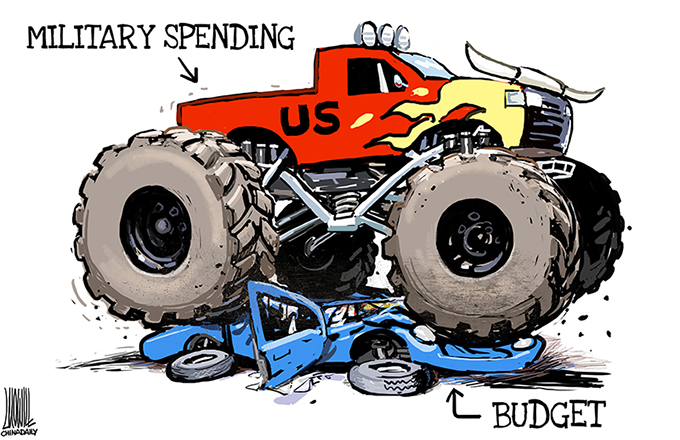
China's defence budget has decreased at a time when US President Donald Trump has called for $603 billion in defence spending, a 10 percent increase in the US' defence budget, which is already more than the combined defence budgets of the eight highest defence spenders after the US. It remains to see how Trump will succeed in "rebuild (ing) the (US') depleted military" while pursuing cuts elsewhere in federal government spending. Getting NATO members to spend up to 2 percent of their GDP might be a smart idea to lessen the US' burden, but slashing funding in other areas of federal spending is unlikely to go down well at home. It looks more like robbing Peter to pay for Paul. China pursues peaceful development. Therefore it will adhere to what it has practiced over nearly four decades, that is, it will not start a war with any other country and keep its military building affordable and sustainable. Only in so doing can the PLA gain fresh momentum for continuous development and attain its goal of realizing full military modernization by the mid-21st century.
The author is an honorary fellow at the Center of China-American Defense Relations of the PLA Academy of Military Science.