The future of the economy looks bright
 |
|
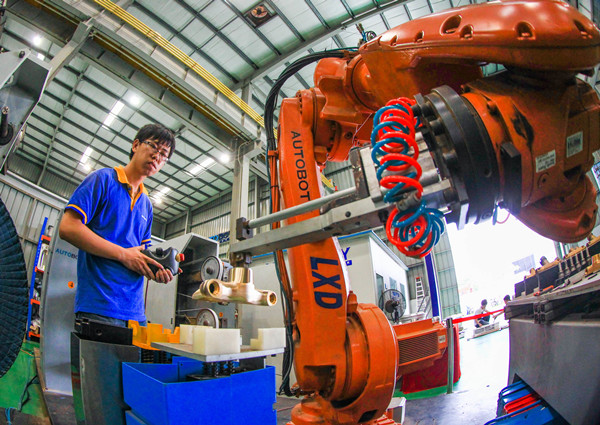
A worker assembles a robotic arm at a factory in Foshan, Guangdong province. [Provided to China Daily] |
China's supply-side structural reform met with preliminary success last year. Some favorable factors stabilized the economy, improving the quality of and optimizing the economic structure. Thus the expected GDP growth of about 6.7 percent was realized.
Still, some major issues are yet to be resolved, indicating the Chinese economy is still under some downward pressure.
Last year, China cut some of its overcapacity ahead of schedule. The housing inventory was reduced, weak economic links were strengthened and progress was made in deleveraging and cost reduction, facilitating the stable recovery of industrial production, and improving and optimizing the industrial structure.
The demand in both external and internal markets is low. Starting from April last year, investments slowed down again, with private investments declining sharply. Investments in fixed assets and private investments increased 8.3 percent and 3.1 percent from January to November, down by 1.9 and 7.1 percentage points respectively, compared with the same period in 2015. The actual increase in retail consumption slowed a little because of the low increase in residential incomes and the effects of the red-hot property market.
Besides, the weak economic recovery of its major trading partners reduced China's exports by 7.5 percent from January to September last year, a reduction of 4.4 percentage points year-on-year.
In 2016, consumer prices grew moderately, mitigating the risks of both inflation and deflation. From January to September, the consumer price index rose 2.0 percent, up 0.6 percentage point year-on-year. With the rebound in primary commodity prices in the world and the gradual implementation of the supply-side structural reform in China, the supply to the industrial product market fell against demand, and the producer price index turned positive. The PPI fell 2.0 percent in the January-November period, down 3.2 percentage points year-on-year.
The economic structural change created more jobs and governments at all levels worked to increase employment. From January to November, 12.49 million new jobs were created for people in urban areas, reaching the goal for the whole of last year ahead of schedule. Industrial enterprises' profits increased 8.6 percent, up 10.6 percentage points year-on-year. Among them, the manufacturing sector's profits rose 13.2 percent year-on-year.
China's economy will face greater downward pressure because of the lack of adequate support for economic growth, financial risks, low private investments and the low growth in residential incomes. Despite that, China's economy is expected to grow by 6.5 percent this year because of the existing growth potential, the change in demand, more dividends released by the 19th National Congress of the Communist Party of China in the fall and deepening reform.
The Central Economic Work Conference in December made it clear that China will deepen the supply-side structural reform this year, moderately expand aggregate demand, vigorously revive the real economy, foster a new momentum, and expedite the implementation of the key reform measures in sectors such as State-owned enterprises, tax, finance and social security.
China will continue its efforts on some major fronts: cutting industrial capacity, especially in the iron and steel and coal sectors while reducing overcapacity in some sectors; cutting housing inventory, especially in third- and fourth-tier cities; lowering corporate costs mainly through tax reduction, lower charges and lower factor costs; and strengthening all weak economic links.
The Central Economic Work Conference laid special emphasis on four areas. First, the fiscal policy will be made more proactive and effective, particularly in reducing the tax burden of enterprises. Second, the monetary policy will be steady and neutral, and focus on fending off and removing financial risks. Third, efforts will be made to revive the real economy. And fourth, priority will be given to establish a long-term effective property market mechanism based on financial, land, tax and legislative measures, based on the principle that "houses are built for living, not speculation". These signal a shift from demand-oriented to supply-oriented regulations.
The author is director of the Macro-economy Studies Office at the Economic Projections Department of the State Information Center.
Source: chinausfocus.com
- What NPC deputies and CPPCC members say about China's economy
- Deepening reforms the only way forward for China's economy
- WeWork leader confident in Chinese economy and market
- Vigorous Chinese economy to contribute big to world growth
- Chinese economy to remain top engine of world growth: Spokesperson
- China's economy continues its transition
- Lead economists' take on the economy of China and the world