Reality check will show double trap is avoidable
 |
|
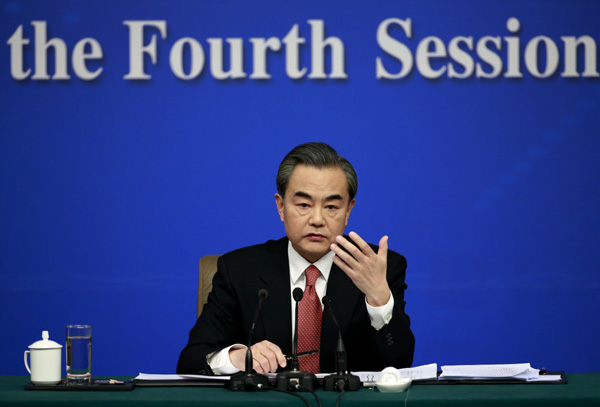
Chinese Foreign Minister Wang Yi takes questions from the press during a news conference on the sidelines of the two sessions on Tuesday. [Photo by Feng Yongbin/chinadaily.com.cn] |
Top Chinese diplomat Wang Yi's call for "American friends" to "brush up" on World War II history may not ring any bells with Washington, because, unlike then, the two countries today are not fighting shoulder to shoulder against a common enemy.
Instead, they find themselves pitted against each other in a murky, yet nonetheless increasingly touted, narrative about the transfer of global leadership.
US President Donald Trump's isolationist "America First" inaugural address and Chinese President Xi Jinping's pro-globalization speech in Davos seem to have indelibly reinforced that narrative for some.
And the impression that a rising China is seeking to take the United States' place at the head of the global table has lent credence to warnings the two countries will be caught in the Thucydides trap, which in turn has fueled attempts to identify potential flashpoints.
The South China Sea is a popular candidate in this regard.
However, while Wang's remarks on the South China Sea were not meant as a tailored response to the underlining of diplomacy first by US Defense Secretary James Mattis, their remarks together point to a shared interest in crisis prevention.
While Mattis essentially excluded military moves on Washington's part, at this point at least, the core message of Wang's reference to history and emphasis on Beijing's persistent peacemaking with other stakeholders is clear: There is no reason for conflict between China and the US in or over the South China Sea.
Given its indirect, informal nature, such interaction may not suffice to eliminate, or even substantially de-escalate, the tensions and worries that have arisen with the narrative of looming conflict. But it is of far-reaching significance for Beijing and Washington to exchange vows not to seek confrontation at such a critical juncture.
The most sensitive part of the narrative of impending conflict is misreading China's national strength and its alleged desire to supersede the US, an allegation that defies the repeated emphasis by Chinese leaders they have no desire for global dominance.
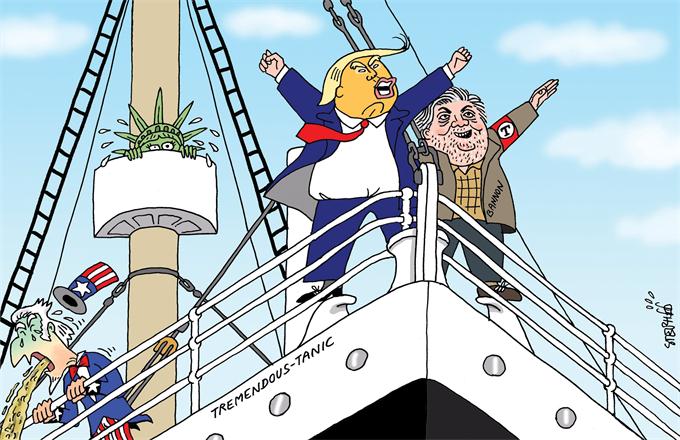
Harvard professor Joseph Nye has cautioned Trump to be wary of the Kindleberger trap, the impression that China seems too weak rather than too strong, as well as the Thucydides trap, triggered by the impression that China is too strong. His warning deserves serious attention because it reminds us of the importance of a reality check.
This is something that is more imperative than ever if the emerging narrative is not to be misguided by perceptions that turn it into a self-fulfilling prophesy.