Smoother festival travel sign of advancing times
 |
|
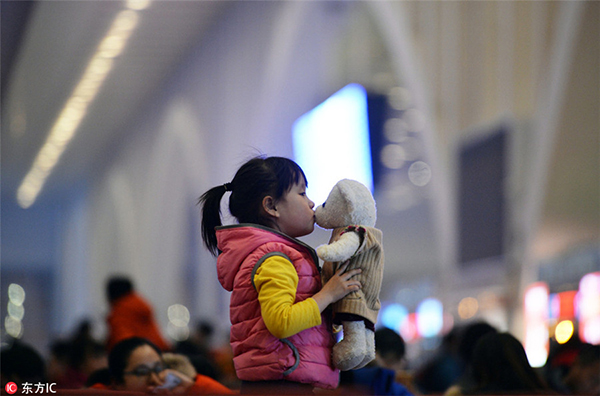
A girl kisses her toy bear at a station in Shijiazhuang, Hebei province, on Jan 14, 2017. The world's biggest human migration during Spring Festival, or Chunyun, started on Friday, which usually means jam packed railway stations and long travel days. [Photo/IC] |
The travel rush at Spring Festival always makes headlines because it strikes a chord with almost everyone in this country. Going back home ahead of the Chinese Lunar New Year's Eve for a family reunion after a year of work, no matter how far one is away, is a duty ingrained in the minds of most Chinese people.
Yet the journey was for long strewn with difficulties and hardships. Just a few years ago getting a ticket could be a headache for many, and long hours in an ill-ventilated, tightly packed train characterized the journeys.
Given its population of more than 1.3 billion, no wonder the Spring Rush is considered the world's largest migration of people. This year, a record 3 billion trips are forecast to be made, by road, rail, water and by air, over a span of 40 days around the traditional festival.
Ten years ago, a little more than half the number of trips were recorded, yet they were accompanied by media reports of stampedes, delayed trains and passengers that were stranded for days.
The lack of drama so far this year, with nearly 900 million trips already made during the first 13 days of the travel rush period, underscores the dramatic changes that have taken place in China's infrastructure landscape, especially its high-speed railways, which have been developed from scratch to become the largest network in the world.
Last year, more than 3,000 kilometers of high-speed railways were interwoven into a national rail network, which now spans 124,000 kilometers, of which 22,000 kilometers are high-speed, 65 percent of the world's total.
For regular travelers, the benefits are immediate and palpable. In a recent instance, the opening of a high-speed railway linking Guiyang and Kunming in December cuts travel time from Shanghai in the east to Kunming in the southwest from nearly 40 hours to eight.
This is a revolution, which though going on quietly, is fast changing our way of life in an irreversible way.
It reflects the rise in China's overall national strength, as it upgrades its industrial structure. The new elements that have emerged to facilitate the Spring Festival transport rush-ticket-selling apps, information-providing robots at stations and face-recognition check-in systems, not only make traveling easy they also reflect China is embracing the digital era.
With a blueprint drafted to expand China's railways to 200,000 kilometers by 2030, of which 70,000 will be high-speed, the journey back home will surely become even smoother in the years to come.