Stricter system required for proper disposal of clinical waste
 |
|
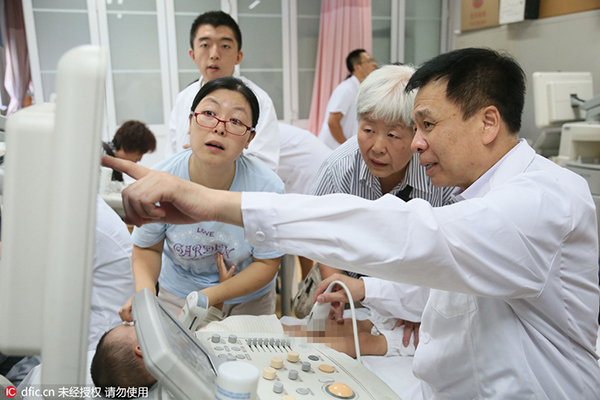
A Chinese doctor talks with family members of a young patient as he examines him with a Type-b Ultrasonic Diagnostic Instrument at a hospital in Beijing, China, 11 September 2013. [Photo/IC] |
A RECENT CASE IN NANJING, capital of East China's Jiangsu province, shows that the authorities must put the disposal of medical waste under strict supervision. Beijing News commented on Tuesday:
The public security department in Qixia district cracked Nanjing's first case of improper disposal of clinical waste recently. It took the police more than three months to catch three people suspected of collecting infusion tubes and bags from hospitals and selling them to plastic processing workshops where they were used to make disposable tableware and plastic toys.
Medical waste differs from other types of rubbish in that it contains large amounts of pathogenic microorganism and bacteria. The disposal of medical waste is an expensive process because it should only be done by qualified professional agents.
If plastic healthcare waste is directly recycled to make other products it poses a potentially fatal threat to public health.
Although proper treatment of the healthcare waste is important and necessary, there is not yet a strict management system in large parts of the country for the safe disposal of healthcare waste so it doesn't threaten human health or pollute the environment.
A city like Nanjing with more than 8 million permanent residents only has one certified recycling company to collect the medical waste, and the hospitals have to pay the company high fees. Illegal collectors not only help hospitals to save costs, but also generate profits for those responsible for disposing of the clinical waste.
Under such a loose supervisory system, the deal becomes a win-win reality for both sides, but largely at the cost of the public's interests.
There is a unique identification code on medical consumables, which can be used to track down the products' use. But such a useful code loses its efficacy once the consumables become medical waste. The authority should extend the lifespan of these codes and let them continue to play their roles until the waste is properly disposed of by qualified recycling agents.
Besides, the monopoly of one medical waste recycling company in one city should be broken by introducing competition, so as to lower hospitals' expenditure on treating their waste.