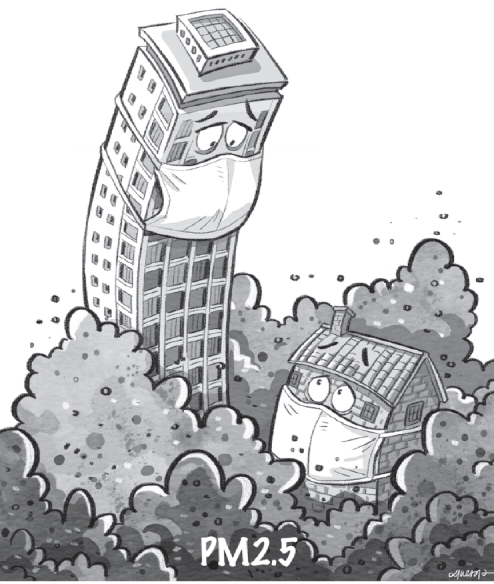
Uneven development adds to air pollution
 |
|
LI MIN/CHINA DAILY |
Politicians and bureaucrats across the world-at local, regional and national levels-h(huán)ave been coming up with new ideas to reduce air pollution. More recently, some have pointed the finger at rural contributions to air pollution in the developing world, especially in India and China.
During Diwali celebrations at the end of October, New Delhi's pollution level was off the charts, cementing the Indian capital's status as the world's most polluted megacity and rekindling a nationwide debate on India's killing smog. Official data from the Delhi Pollution Control Committee showed hazardous levels of smog, with concentrations of both PM2.5 and PM10-h(huán)armful particulates with a diameter of 2.5 and 10 micrometers or less-h(huán)itting levels more than 30 times the World Health Organization's recommended 24 hour average limit.
Over the last few years India has held multiple conferences and workshops to find a solution to the smog. A regional approach is the most common suggestion to have emerged from these conferences, but the situation on the ground has not changed. In fact, it is getting worse with each passing year.
India has more than 100 coal-based power plants (and over 400 units) with old technology, with burning of crop remains adding to the emissions. And New Delhi's notorious pollution is the result of a noxious cocktail of emissions from vehicles and coal-fired power plants, fumes from cooking stoves and crop-burning in neighboring provinces.
In Beijing, where air pollution is being treated as a health emergency, the government can order cars off the road and shut down schools and industries if particulates threaten to rise to the highest WHO level-New Delhi's level of pollution is unimaginable in Beijing.
North China, which battles smog in the winter, also has the problem of crop burning. So pollution created by crop burning is not a problem unique to India. Some local governments in China are penalizing farmers who burn their crop remains and thus contribute to the air pollution in nearby cities. The problem is, farmers often burn crop remains as it is the only way to treat remains, and they have to burn coals to keep warm during the freezing winter in North China because they lack other means of heating.
Some will say this reflects elements of unbalanced economic development and the unfairness between rural and urban areas is at the heart of the issue. The industry-based development in big cities such as Beijing and Shanghai would not have been possible without drawing water, energy and human resources from nearly regions, which were encouraged to focus on agriculture at the expense of development. Now, as the big cities shift to the service sector in their pursuit of cleaner air, the regions are again under pressure to forego environmentally polluting development. Understandably, they are resisting it.
Many people ask what options farmers have to keep themselves warm in the winter except by burning crop remains.
Clearly more needs to be done for rural development and offering farmers other sources of heating during the winter months. Ideally, they should be provided with alternative energy sources, solar power or natural gas for example, to keep their homes warm in the freezing winter.
This can be achieved by China without much difficulty, because the country leads the world in investment in renewable energy. The scheme, however, needs to be targeted at rural farmers if we want them to stop adding to the air pollution of cities. Such a development is something I look forward to during my visits to China.
The author is a former member of London Assembly.