Has two-child policy had the desired effect?
 |
|
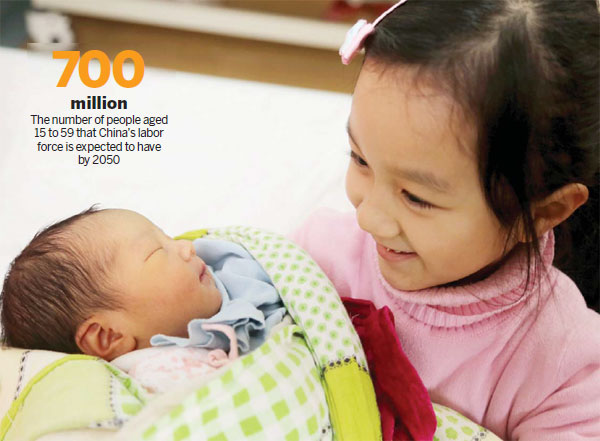
Xue yaqing, 6, holds her brother on New Year's Day at No 1 Hospital in Xiangyang, Hubei province. The newborn is the second child of a couple from the city in Central China. [Photo/Xinhua] |
As the two-child policy approaches its first birthday, commentators and the Chinese government are looking for evidence to see whether it has had the desired effect: an increase in the birth rate in order to mitigate some of the effects of an aging population.
At first glance, the evidence seems to be promising. It is estimated that there will be around 17.5 million births in 2016. At over one million more than in 2015 one might say the two-child policy has been a success. Without doubt, many couples have seized the opportunity to have a second child, realizing both a personal dream and a favorable outcome for the country. However, there are a few words of caution.
Firstly, as the Year of the Sheep, 2015 was widely perceived to be a not-so-good year to have children. Numerous studies have said the influence of the zodiac is still strong among the Chinese. It is likely, then, that many would-be parents may have simply postponed having children in 2015, choosing instead to have babies in the more favorable Year of the Monkey. Indeed, if we look at the longer-term trends, the number of births in 2015 actually fell from 2014.
Secondly, we still do not know the total impact of what demographers call the "tempo effect". As countries develop and, especially, as educational and employment opportunities for women grow, childbearing tends to be postponed. As this has happened in most low fertility countries, we can expect this to have happened in China, too. The problem, however, is that this effect tends to distort the total fertility rate, usually exaggerating both baby busts and baby booms. Also, simply counting the number of births tells us very little about the birth rate, as this is going to be affected by the number who are "at risk" of having children. In China, of course, this is going to be related not just to being of reproductive age, but also to marital status.
Taking these elements together, therefore, we have to conclude that it is just too soon to say whether or not these changes in family planning are having the desired effect. We will know more in a few more years when we have better period data with which we can identify a trend. In reality, though, it is only when the cohorts born in the 1980s and 1990s have completed their childbearing will we see the true demographic impact of the policy change.
Two final notes of caution. The evidence seems to suggest that changing the family planning policy alone will not be enough to make a significant difference to the fertility rate. As elsewhere in East Asia, concerns about jobs, social welfare, cost of living, housing, kindergarten access, gender equity and so on have as much impact upon the decision to limit childbearing as family planning policy. Alleviating these concerns is critical to increasing China's low fertility rate.
Secondly, it is critical to remember that raising the birth rate alone is not the only answer to managing China's aging population. Indeed, in the short term, it would increase the burden on the working age population by necessitating an increased number school places and the withdrawal of parents from the labor market to care for these children. Rather, China needs to take a holistic approach to this demographic challenge, and will have to deal with both the denominator and the numerator. On the one hand, improving labor productivity, moving up the value chain of innovation, increasing labor force participation, further reforming the State-owned enterprises and developing the global labor supply chain through the Silk Road Economic Belt and the 21st Century Maritime Silk Road will be critical to maximizing output. On the other hand, reforming and developing better social welfare systems for the elderly as well as making progress in active aging policies will not only decrease the dependence of the older population, but could also free up the monies accrued as a result of high personal savings rates and, hence, spur domestic consumption.
The author is associate professor of social policy at the University of Oxford.
- Two-child policy could see rise in deaths during pregnancy
- Two-child policy working, birthrate figures show
- Conaprole hopes to cash in on nation's two-child policy
- Two-child China promises better maternity services
- Industries related to two-child policy booming
- Hospital simulates two-child family for single children
- Two-child question worries female job seekers in Chongqing
- Two-child policy alone can't fix aging problem