Economy still strong despite yuan's fall
 |
|
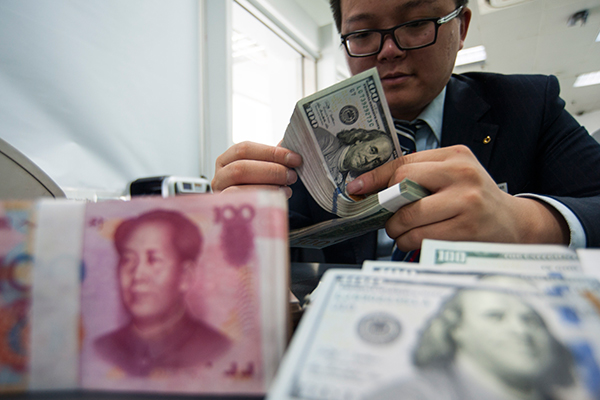
An employee at a bank counter in Nantong, Jiangsu province, counts renminbi and dollars. [Photo/China Daily] |
The yuan's continued depreciation against the US dollar since September has aroused concerns about possible capital flight from China, especially because the country's foreign investment in the non-financial sector surged by more than 53 percent year-on-year to reach $145.96 billion in the first three quarters of this year. The figure for the whole of last year was about $121.4 billion.
In response, the Chinese government, as confirmed by officials of the People's Bank of China, the National Development and Reform Commission and other government departments, will more tightly scrutinize overseas investments while implementing the "Go Out" strategy.
Observers and investors, however, need not worry, nor should they fall victim to speculations. The truth is that the yuan is still stable in the global monetary market and will continue to be so. The recent depreciation is a natural market response to a stronger US dollar after Donald Trump's election as the next US president and the possibility of the US Federal Reserve increasing interest rates.
The Chinese currency's exchange rate is no longer pegged to only the US dollar thanks to the increasing globalization of trade. The China Foreign Exchange Trade System index, which now serves as a major indicator of the value of the yuan, has stayed above 94 in the second half of this year. The US dollar's ratio to the CFETS weight is just above 26 percent, a figure not big enough to sway the yuan's exchange rate. Viewing the yuan's value against a basket of currencies instead of a single currency would therefore be more accurate.
Admittedly, China's foreign reserve declined from nearly $4 trillion in 2014 to about $3.12 trillion by the end of October, fueling concerns about potential capital outflows. However, nearly half of the decrease of around $870 billion was related to the country's net overseas assets held by its nongovernmental enterprises, which increased by about $424.2 billion by the end of the second quarter.
That said, the recent fluctuations in China's foreign exchange reserves do not necessarily herald large-scale and disorderly money outflows, which are not on record. They are a result of the increasing attempts by Chinese enterprises and individuals to build up their overseas portfolios.
Chinese enterprises' overseas mergers and acquisitions amounted to about $111.9 billion last year, and the figure for the first three quarters of this year is at least $170 billion. This is not all. During the first 10 months, China received foreign direct investments of about $103.9 billion, even registering a slight year-on-year increase of $200 million. The record investment level speaks volumes of the health of the Chinese economy, especially given the sluggish global capital flows.
That China remains an attractive destination for foreign investments and multinational companies has a lot to do with its huge market and ongoing economic reform. The world's second-largest economy still enjoys stable growth and rising consumption. It is also making more efforts to overhaul its manufacturing and service sectors, where large potentials of artificial intelligence and green energy remain untapped.
The success of free trade zones such as the China (Shanghai) Pilot Free Trade Zone, on the other hand, adds weight to the Chinese government's determination to streamline administration to create an investor-friendly environment.
It would be wrong to underestimate China's economic resilience. With the prospects of the Washington-led Trans-Pacific Partnership Agreement growing dimmer and the Regional Comprehensive Economic Partnership championed by Beijing moving on the right course, China is expected to play a bigger role in regional economic integration.
The author is a senior researcher at Suning Institute of Finance affiliated to Suning Appliance Co.