US trumps developing world's climate deal
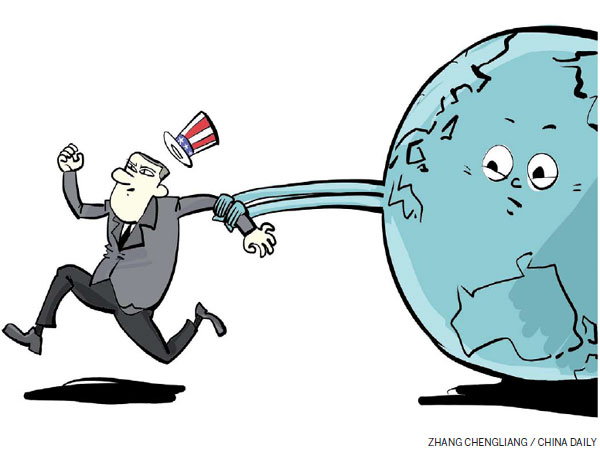
The United Nations climate change conference in Marrakech, Morocco, concluded on Nov 20 without making any substantial progress, because it was tasked with charting the course of implementing the climate deal reached in Paris in December 2015.
Although the Paris agreement has been ratified by 105 countries at last count, including China and India, it is not fully in the spirit of the Kyoto Protocol and many see it as rewarding the big defaulters who also happen to be, historically, the biggest polluters-the countries in the developed North.
There are two categories of such countries: those that agreed, under the Kyoto Protocol, the principle of historical culpability and the principle of "common but differentiated responsibilities" to reduce emissions more deeply than developing countries, but reneged; and those that refused to ratify the protocol, led by the historically biggest emitter of greenhouse gases (GHGs), the United States.
The Kyoto Protocol was based on the principle that since the developed countries emitted huge amounts of GHGs for more than a century during their industrialization and development drives, they should yield "emission space" to the developing countries. Consequently, it was further incumbent on them not only to undertake more stringent, and binding, emission cuts but also help developing countries to chart cleaner growth trajectories through financial aid and technology transfers.
None of this happened on a scale significant enough to make the kind of impact necessary to arrest climate change. The US refused to ratify the Kyoto Protocol: its position was that of classical climate change denier, with former US president George H.W. Bush saying the American way of life was not up for negotiation.
The Paris climate agreement buried the Kyoto Protocol and the principle of "common but differentiated responsibilities" and placed all countries, irrespective of their historical contribution to GHG emission or level of development, in the same position of having to undertake binding reduction targets, even if, obviously, the depth of cuts were not envisaged to be matching. Critically, the cuts accepted by the Barack Obama administration, although Obama himself is a not climate change denier, were nowhere near the levels required to keep the temperature from rising 2 C above pre-industrial levels, which climate scientists say is just short of the tipping point. The US is vital to any climate treaty because in the absence of adequate action by it, cuts accepted by most countries of the global South (including China and India) won't cut the mustard.
Perhaps the leaderships of the countries of the South should have done more to compel the developed world to fulfill its responsibilities. India is especially guilty of selling out.
For years, successive Indian governments have been clear that the Kyoto Protocol framework should be the basis for the fight against climate change. It was clearly in assiduous pursuit of the "special relationship" with the US that the Indian government craved so desperately. While previous Indian governments resisted the urge to give in to the demands of the developed world, especially the US', this one has, literally, stooped to genuflect before Washington's interests.
This is not to say that India should not take urgent steps to reduce emissions. The recent crisis in Delhi caused by extremely hazardous air quality, which almost shut down the city, is enough of a warning.
Action, however, should be taken by countries of the South on their own terms, rather than under the pressure of developed countries. India has, in fact, been running an emissions-reduction program to meet voluntarily set targets, which will not hurt commitments to development and factor employment.
Now that Donald Trump, who is a self-proclaimed climate change denier, has been elected US president, the climate deal is back in the mix. If Trump sticks to his known anti-climate change stance, the only option would be to go back to the Kyoto Protocol and hope the White House accepts its principles.
The writer is a senior journalist based in India.