Making sense of life on a remote cliff top
 |
|
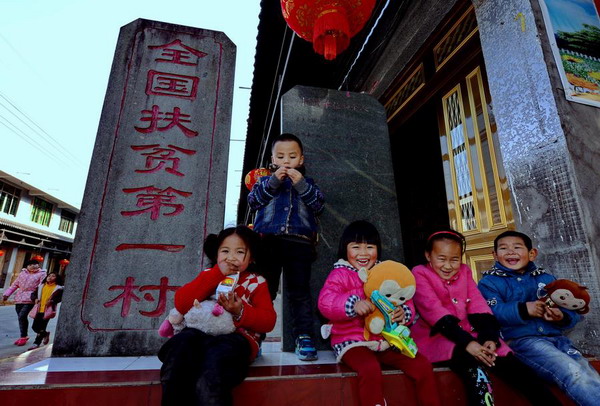
Children of She ethnic group sit in front of a monument that reads "China's No. 1 Poverty Relief Village" at Chixi Village, Panxi town, Fuding city in East China's Fujian province, Feb 14, 2016. The village has shaken off poverty thanks to assistance from Party and government officials at all levels over the past 30 years. [Photo/Xinhua] |
The steel-tube ladder is steep, 60 degrees, but it is safer than the old rattan ladder that consisted of nose-to-tail 17 sections on way to an 800-meter-high cliff. The new ladder, coated with blue antirust paint, came into use on Monday. And for more than 20 children of the Yi ethnic group from Le'er village, Zhaojue county in Southwest China's Sichuan province, the vertigo-prone journey to and from school has become easier, so to say.
It took the local government about six months and 1 million yuan ($145,000) to build the new ladder, which can be used for about 20 years, after the children's dangerous journey to school hit the headlines nationwide. Dozens of families in Le'er village have lived a hand-to-mouth existence on the cliff top, where they took shelter to escape the tribal war more than 200 years ago, according to their oral history.
What is more, they are reluctant to relocate to the foot of the cliff even today fearing the loss of their land. And the county government cannot afford millions of yuan to build a road connecting the village with two small villages deep in the mountainous region.
The central government has vowed to lift the over 50 million people out of poverty in China by 2020, which cannot be achieved without the active support of local governments. And the Le'er village reflects the difficulties this plan faces.
The effect of economic growth on poverty alleviation has progressively declined since the 1990s. Chinese Academy of Social Sciences data show the poverty-stricken population in China fell by 13.2 million with every percentage point of GDP growth from 1978 to 1990. But that figure dropped to 3.8 million in the 1990s, and was only 1 million in the early part of the 21st century.
The problem is not that the government has decreased its input for poverty eradication but that poor people are now mostly concentrated in remote places, and their poverty can be attributed to complicated factors such as transport, culture, education levels and their local economies. As a result, the cost of reducing poverty has increased.
Take the Daliangshan Yi autonomous prefecture in Sichuan, of which Zhaojue is a part, for instance. Most Yi people lived in a society marked by slavery till New China was founded. No wonder local residents describe the development and poverty alleviation programs in the region as "one stride in 1,000 years".
International experiences tell us the development of agriculture plays an important role in the early phase of poverty reduction, and non-agricultural policies, such as education and industrial and social policies, gain weight as the poverty-alleviation measures start taking effect.
As for the people living in abject poverty, like the Le'er villagers, building the steel ladder is not enough. Media reports say some children in the village do not go to school at all, even if the nine-year compulsory education is free. Local civil servants need to make more efforts to raise the awareness of villagers about the importance of education. Illiteracy is a big obstacle in poverty alleviation, and it is easier to make educated people see rationality and bid farewell to superstition and backward ideas. For that, officials have to patiently have face-to-face communication with the villagers. The local government should also set aside some special fund for training programs to impart new skills to the villagers and encourage them to make a living away from the mountains.
China's experience in poverty alleviation shows that Le'er needs a role model villager, who has improved his/her life with the help of education and/or mastering special skills. Only then will the other villagers try to follow the same path.
The prefecture government can help the Zhaojue county government to make arrangements for the Le'er villagers so that they can sell their pepper and goats in a bigger market, and thus create more jobs at home, especially for the senior villagers. Perhaps the village can also be developed as a tourism destination, as it commands breathtaking views of picturesque valleys, and the local ethnic culture and craftsmanship can be big tourist attractions.
The author is a writer with China Daily. liyang@chinadaily.com.cn