Helping Venezuela to honor commitment
 |
|
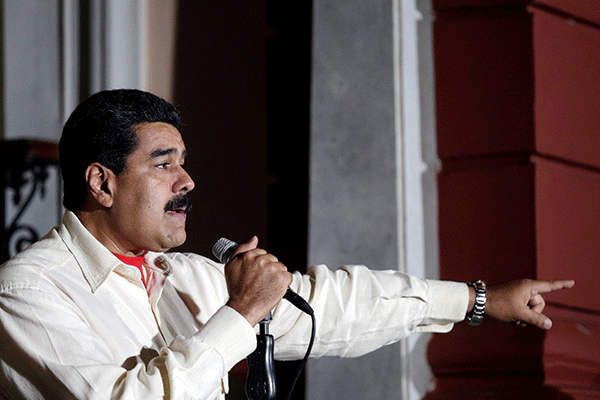
Venezuela's President Nicolas Maduro talks to the media after his meeting with former Spanish prime minister Jose Luis Rodriguez Zapatero in Caracas, Venezuela October 31, 2016. [Photo/Xinhua] |
In a recent televised address that coincided with President Xi Jinping's third visit to Latin America since 2013, Venezuelan President Nicolas Maduro thanked China for "not giving up on" his country during hard times.
His expression of gratitude came at a time when Venezuelan state oil company PDVSA and China National Petroleum Corp reached a $2.2 billion agreement; the two companies are expected to jointly produce 277,000 more barrels of oil a day. Although not on Xi's latest diplomatic itinerary that took him to Ecuador, Peru and Chile, Venezuela is motivated to deepen bilateral ties with China to tide over the crisis it faces at home and abroad.
Recession has stifled the country's economic growth, which has shrunk by 8 percent this year and will probably decline by another 4.5 percent in 2017, according to the International Monetary Fund. Venezuela has a long way to go to overcome high inflation and rapid devaluation of its currency, clear its heavy debts, and ensure the smooth supply of necessities.
Political divisions, on the other hand, keep growing between the ruling United Socialist Party of Venezuela and the opposition Democratic Unity Roundtable despite two rounds of talks monitored by the Union of South American Nations and some regional leaders.
On dialogue, the Maduro government wants to prioritize how to achieve economic stability, whereas the opposition is more interested in holding a recall referendum on the president or a leadership election ahead of schedule.
Diplomatically, Venezuela also faces mounting geopolitical pressure. It is no longer as close to some of its neighbors as it was in the past. The United States, which has had a sour relationship with Venezuela for long, has just elected a businessman known for his hawkish, conservative views on foreign policy, as president.
Despite that, China has good reasons to maintain economic ties with the troubled South American country and help it get out of hot water. For starters, it could advance bilateral trade exchanges in the national interest, because Venezuela has become a major trade partner and investment destination in Latin America for China. Both countries have also deepened their cooperation in a slew of sectors ranging from energy and infrastructure to agriculture and finance over the years.
There have been concerns about whether China can obtain a fair share of its enormous investment in Venezuela given the latter's political and economic struggle. But that does not justify the argument that China needs to get out of the "muddy water" as soon as possible to "cut its loss".
Home to the world's largest oil reserve, Venezuela is still capable of repaying its debts by exporting oil and oil products. The country's state oil company is stepping up cooperation with China, India and Russia, which can improve its productivity.
Besides, the Maduro administration has kept a decent record of repaying debts, and it is seeking solutions to alleviate the foreign debt pressure. It has made interest and principal payments of over $60.3 billion since 2014, paying $16.7 billion this year alone.
Lending a helping hand to Venezuela is not only about protecting Chinese investments in the country, but also about keeping China's diplomatic promises. The Chinese government still stands firm on its commitment to building a community of shared destiny between China and Latin America, as Xi reiterated during his three-nation visit to Latin America. And the key to protecting China's increasing overseas investments lies in scientific risk assessment, prevention and control, not convenient relocation.
The author is a researcher of Latin American studies at the Chinese Academy of Social Sciences.