Visit to smoothen trans-Pacific trade routes
 |
|
Visitors look on an exhibit at the exhibition "Forbidden City, Imperial China", in La Moneda Cultural Centre, in Santiago, capital of Chile, on Sept 2, 2016. [Photo/Xinhua] |
"Timing isn't everything - it's the only thing" is a mantra I used to hammer into my students and now into my staff. President Xi Jinping is visiting Ecuador, Peru and Chile, during which he will also attend the 24th APEC Economic Leaders' Meeting in Lima on Saturday and Sunday, at a critical time for Sino-Latin American relations. Needless to say his visit may have a lasting impact on China-Latin American relations.
That this is Xi's third visit to Latin America in four years speaks volumes about the priority China assigns to the region (as it happens, this is also his third visit to Chile - his first was as Zhejiang province Party chief in 2005, and later as Chinese vice-president in 2011).
Why is this visit different from the ones in 2013 and 2014?
During Xi's previous visits, Sino-Latin American relations were riding high on a wave of fast-growing cross-Pacific trade, a decade and a half in which China's seemingly unending appetite for the region's natural resources led to a veritable boom and much progress.
Between 2000 and 2014, trade between China and Latin America and the Caribbean multiplied, growing from $10 billion to $267 billion. For several countries in the region, including Chile and Peru, China became the largest trading partner; for many others it was the second-largest. As a result of what Kevin Gallagher has called the "China boom", LAC economies grew at a fast clip, paid up their debts and saw their foreign currency reserves swell.
Fast forward to 2016, and a very different picture emerges. Sino-LAC trade was down to $230 billion in 2015. For a second year in a row, Latin America will be hit by negative growth. Some argue that the "Chinese bubble" has burst, that trade with China has led to Latin America's de-industrialization, and that the time has come for the region to go back to the good old days of focusing on the United States and Europe as its main trading partners (never mind that a major wealth shift has taken place since 1990 from the North Atlantic to the Asia-Pacific, making this quite unrealistic).
Until recently, this narrative ran parallel to another, the one on global governance. According to this story, while the BRICS may have been "the acronym that defined a decade" in the first years of the new century, by 2016, owing to the developments in Brazil, Russia and South Africa, BRICS was in the tank, and the North Atlantic powers, most prominently the US and the United Kingdom, were back in the saddle. After a brief disruption of the established global order by a few Global South parvenus, things were back to normal, or so the story went, and endearing photographs of cozy G7 summits around small tables circulated.
And then reality hit. First with Brexit on June 23 this year. Then came the result of the US presidential election. Now it is no longer the basis of the European order that is in question. This time we are talking about the survival of the liberal order that has underpinned the international system since the end of World War II.
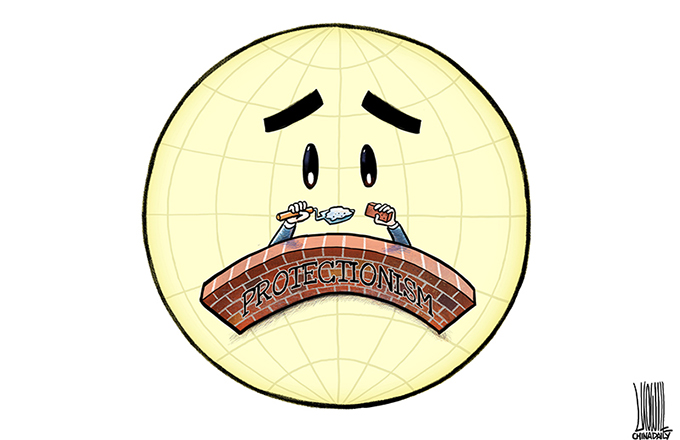
Enter the dragon. At the G20 Leaders Summit in Hangzhou in early September, China led the way with an ambitious agenda that put continued support for globalization, for more liberal international trade and for putting down the ugly head of protectionism. Now at the APEC meeting in Lima, a top task is to look for ways to give a new impetus to trans-Pacific trade. One alternative is the Free Trade Area of the Asia Pacific, for which the results of a feasibility study will be presented in Lima. China should play a critical role in promoting the FTAAP, a project Chile supports. Hand in hand with greater financial cooperation and investment, it could give a big boost to Sino-LAC links.
Latin America has come a long way. But it still has some way to go before it is ready to make the great leap forward to a fully developed condition. In so doing it should partner with China, which in 2016 has emerged as the last remaining great power willing and able to champion the cause not just of a liberal trading order, but also of the defense of the very survival of our planet by slowing climate change. In this partnership, President Xi's visit to South America could emerge as a real milestone.
The author is the ambassador of Chile to China.
(China Daily 11/19/2016 page5)