What the Sixth Plenum will come up with
 |
|
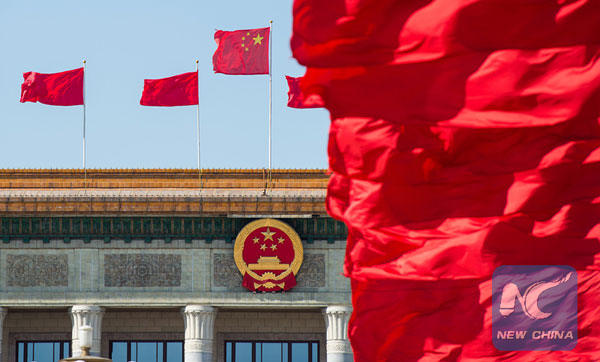
Red flags on the Tian'anmen Square and atop the Great Hall of the People in Beijing. [Photo/Xinhua] |
The ongoing Sixth Plenum of the 18th Central Committee of the Communist Party of China is very important, because the core documents of the four previous sixth plenums of the Party Central Committee led to, respectively, the promotion of culture, building of a harmonious society, improvement in Party work style, and boosting of social morale.
The ongoing Sixth Plenum, instead of being only a political showpiece, will come up with rich, substantive contents. This observation is based on two considerations. First, the Sixth Plenum will make new political rules for the Party's rank and file and revise the rules on intra-Party supervision after taking into consideration participating CPC officials' comprehensive evaluation of the Party's work over the past four years, the anti-corruption campaign in particular. And as the crackdown on corruption enters the stage of prosecution and trial, people will begin to shift focus on long-term mechanisms.
Top leader Xi Jinping made two vital remarks at the beginning of the anti-corruption campaign. One was to "lock corruption into the cage of systems" and the other was to "make leading officials 'dare not', 'cannot' and 'do not want' to engage in corruption". On his part, Wang Qishan, who heads the CPC Central Commission for Discipline Inspection, pledged at the time to "win time for the establishment of anti-corruption mechanisms with heavy blows".
Through the series of rectification moves and harsh punishments meted out to corrupt officials, the political biosphere in the CPC has more or less been purified. Besides, public anger against corruption has gradually turned into anticipation for durable anti-corruption mechanisms. As such, enactment of rules and regulations reflecting rigid restraint as well as strict oversight has become a matter of course.
The second, and more important, reason the ongoing Sixth Plenum will propel substantial changes is that it is necessary for every Party member and organization to share common ideals and abide by the Party's discipline. Such an imperative has to do not only with the CPC's present state, but also with the tremendous pressures created by China's stagnating economy and rising social contradictions.
Behind the slowing economy is a reality: economic restructuring, reducing overcapacity, ensuring healthy investment levels at home and abroad, and maintaining a basic balance between imports and exports are not only difficult to achieve tasks but also come with financial risks. Severe challenges also confront urbanization, poverty alleviation, unemployment reduction, environmental protection, food and drug safety, and public security, especially when it comes to addressing problems such as telecom scams that involve personal information.
Such challenges are a combination of the historical contradictions accumulated since the beginning of reform and opening-up, and the recent contradictions, are the logical outcomes of the country's intensive reforms, and a severe test for public administration.
Fortunately, the CPC is a party of nearly 90 million members and a total of 4.36 million grassroots organizations. With members accounting for nearly 10 percent of Chinese above the age of 18 years and cells across the country, from every village and urban neighborhood to every State organ, and public and private enterprise-even foreign companies with Chinese staff-the Chinese government need not worry much about implementing its policies.
Some may see this as the Party performing the government's functions. But judging from the extensive and strict nature of Party organizations, and from its 67 years' experience of leadership, the CPC has developed quasi-government capabilities for governing, organizing and integrating Chinese society.
The essence of the ongoing Sixth Plenum and the documents it endorses, therefore, will be general mobilization of the Party's rank and file in the face of practical difficulties.
The author is a research scholar at the China Foundation for International and Strategic Studies.
Source: chinausfocus.com
- CPC to convene plenum from Oct. 24 to 27
- Infographic: Top agendas of all 'Sixth Plenary Sessions'
- Facts about the 6th plenary session of the 18th CPC Central Committee
- What to expect from CPC's upcoming plenary session?
- Schedule for the plenary in Beijing
- Plenary meeting of NPC deputies from Tianjin held in Beijing