Peace underpins China's space endeavors
 |
|
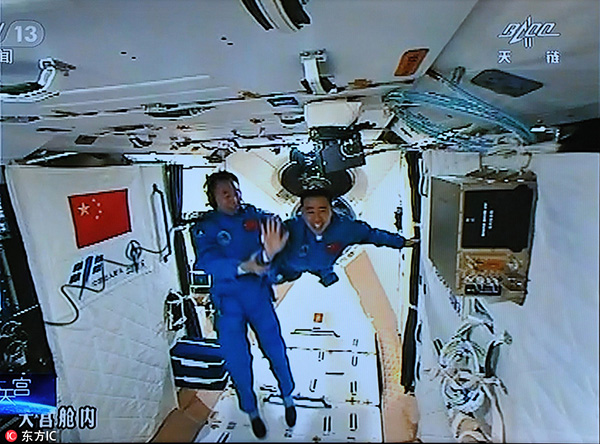
Two astronauts Jing Haipeng and Chen Dong aboard the Shenzhou XI spacecraft enter the space lab Tiangong II at 6:32 Wednesday morning Beijing Time. [Photo/IC] |
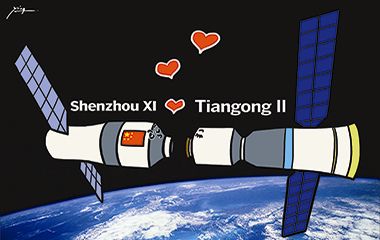
Shenzhou XI, China's sixth manned spacecraft, docked with space lab Tiangong II on Wednesday, bringing the nation's planned space station one step closer to reality.
Although China's efforts to become a space power are being made in the spirit of peace, coverage by Western media of the successful launch of Shenzhou XI on Monday alluded to China's space program having a military background.
Mentions of China's commitment to international cooperation and sharing lessons from its manned space program with other countries, especially developing countries, were absent in much of the coverage, which instead focused on the mission's supposed military elements.
Yet driven by the principle of the peaceful use of space, China has signed multiple cooperation agreements with over 30 countries and organizations including Germany, France, Russia, Kazakhstan, the European Space Agency and the United Nations Office for Outer Space Affairs.
The nation's manned space engineering office has said it will expand international cooperation on equipment research and development, space applications, astronaut training, joint missions and aerospace medical care.
During the past decades, China has made rapid and remarkable achievements in its space technology program, which have been met with worldwide approval.
It should come as no surprise that rather than seeking military deployment in space, China is actively engaged in scientific exploration through experiments conducted during the space missions. This is the major theme and goal of the program.
China's trajectory has proved that its space exploration is peaceful, diverse and productive.
In 1999, Shenzhou 1 tested space mutation breeding by carrying seeds, including green pepper, melon, tomato and licorice, as well as bioactive strains that could help to develop medicines for cardio-cerebrovascular diseases.
China worked with Germany in 2011 on the Shenzhou VIII mission, which featured cooperative experiments in life science on board the spacecraft.
Chinese astronauts on the 2012 Shenzhou IX mission completed 15 experiments in aerospace medicine. During the Shenzhou X mission the following year, more space-specific medical experiments were conducted, in addition to technical tests and a lecture delivered to students on Earth.
- Astronaut answers netizen's questions in first diary
- Shenzhou XI astronaut to spend 50th birthday in space
- Interview: European ex-astronaut applauds progress, advises peers in China's manned space program
- Shanxi astronaut blasts into space for third time
- The space blue: China unveils new astronaut suits
- Astronaut Chen Dong: From naughty boy to inspiration
- Veteran astronaut soars to new heights