Xi's visit to highlight China's presence in Mideast
 |
|
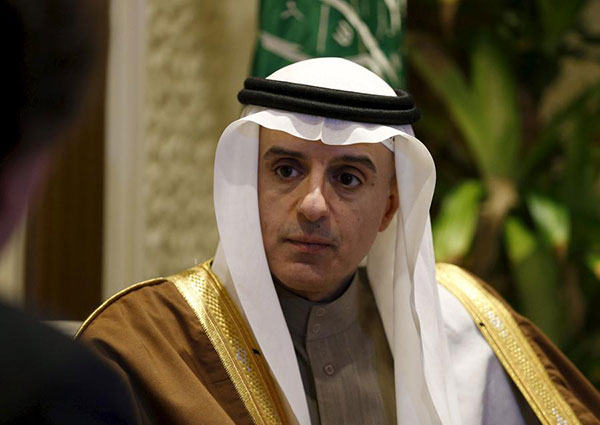
Saudi Arabia's Foreign Minister Adel al-Jubeir attends an interview with Reuters, in Riyadh January 4, 2016.[Photo/Agencies] |
President Xi Jinping will embark on a tour of the Middle East on Tuesday during which he will visit Saudi Arabia, Egypt and Iran. His first foreign visit to the region, also his first diplomatic tour of 2016, comes at a crucial time for not only Cairo but also the whole of the Middle East.
This year marks the 60th anniversary of the establishment of China-Egypt diplomatic relations; in fact, Egypt was the first country in the Arab world to establish diplomatic ties with China. But Egypt, along with many other Middle East countries, is now desperately seeking lasting peace and development to tackle the economic difficulties and social unrest the "Arab Spring" left behind. And this is precisely where China comes into the picture, because it has both the will and capability to contribute to peace and development in the Middle East.
As a traditional major player in the region and home to the Arab League headquarters, Egypt can still lend fresh momentum to China-Middle East cooperation like it did six decades ago. But unlike the bilateral interactions in the 1950s and 1960s, which mainly revolved around mutual political support, Xi's visit is aimed at helping more local people, especially those in violence-prone areas, to enjoy the dividends of economic development.
Saudi Arabia and Iran, two major oil suppliers of China and key elements of its Belt and Road Initiative, also have enough reasons to be on Xi's Middle East tour itinerary. Despite the Teheran-Riyadh row over the execution of Shiite cleric Nimr al-Nimr on terrorism charges by Saudi authorities, the two major Middle East players remain important for China and the rest of the world.
That is why China will not side with any Middle East country in regional conflicts or abandon its stance of having good relations with all regional countries while maintaining equidistance from them. After all, a peaceful and stable Middle East is in the interest of all relevant parties.
Beijing is expected to strike a delicate balance between Riyadh and Teheran. Sectarian tensions between Saudi Arabia and Iran, contrary to speculations, are unlikely to hamper Xi's visits to the two countries, because China's relationships with them are mostly bilateral, not multilateral, and are focused on neutral economic exchanges.
Of course, the Chinese president is expected to promote the Belt and Road Initiative's projects during his visit to the Middle East and consolidate the energy-based cooperation between China and the region. Besides, Beijing has to respond positively to the recent visits of Arab leaders seeking closer political and economic cooperation with China. Xi is expected to convey that positive response.
Western powers' motives were exposed after instigating the "Arab Spring", they washed their hands of the consequences. In contrast, China has always insisted that outside forces have no right to interfere in a country's internal affairs and that the fate of a country should be decided by its people. In this context, Xi is expected to make clear China's stance on some outstanding Middle East issues while welcoming efforts to tap into the economic potentials of China-Middle East relations.
Trade and investment cooperation will play a central role in China-Middle East relations, with a number of bilateral agreements and memorandums in infrastructure and transportation projects likely to be signed during Xi's visit.
As for the fight against terrorism, the Middle East is facing severe challenges, especially from the Islamic State. And the fact that China has similar concerns calls for China and Middle East players to coordinate their actions so as to deal a deadly blow to terrorism in all its forms across the world.
The author is an associate researcher on Middle East Studies at the Chinese Academy of Social Sciences.