
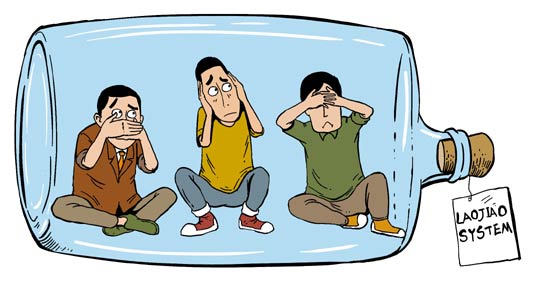
One of the most hailed pieces of news to emerge from the Third Plenary Session of the 18th Communist Party of China Central Committee in November was the decision to abolish the long-standing, controversial correction system known as "re-education through labor," or laojiao.
The system originated in the mid-1950s as a means of dealing with "counterrevolutionaries" and "rightists," but from the 1980s its focus was expanded to target various forms of social deviancy, ranging from petty theft to prostitution and drug abuse. It enabled the police to sentence habitual petty criminals to up to four years detention without trial. Most recently, so-called illegal petitioning was added to its list of offenses.
The Laojiao program has caused several highly controversial incidents in the last few years.
The most widely known case is Tang Hui, a 40-year-old mother who was put in the program in central China's Hunan Province, for petitioning for harsher punishments for those found guilty of raping her daughter and forcing her into prostitution. In July, a high court in Hunan ruled in favor of her when she sued the local authority for infringing upon her personal freedom and causing psychological damage.
Legal experts have widely criticized the program and argued that it contradicts laws.
The system's fundamental flaw lay in the fact that it effectively allowed people to be deprived of their freedom without even being tried by the courts.
"The abolition of laojiao is a triumph for Chinese legal practitioners, and most significantly the Party has shown a genuine interest in acting on people's will, in rectifying social injustice and improving the rule of law," said Zhou Yongkun, a law professor at Soochow University in Jiangsu province and one of the most vociferous critics of the laojiao system.
Equally impressive in 2013 were China's efforts to prevent and redress miscarriages of justice. In November, the Supreme People's Court issued a document on establishing a mechanism to rule out evidence and testimonies obtained through coercion or other illegal means and to prevent wrong verdicts in criminal cases.
The guidelines clarify that a court should rule a defendant innocent if the evidence is not enough to obtain a conviction. The Supreme People's Procuratorate and the Ministry of Public Security have taken similar approaches to promote fairness and justice in law enforcement and protecting human rights.

Copyright 1995 - . All rights reserved. The content (including but not limited to text, photo, multimedia information, etc) published in this site belongs to China Daily Information Co (CDIC). Without written authorization from CDIC, such content shall not be republished or used in any form. Note: Browsers with 1024*768 or higher resolution are suggested for this site.
License for publishing multimedia online 0108263 Registration Number: 20100000002731 

