Comments
  Print
Print  Mail
Mail  Large Medium Small
A senior official of China's family planning authority said Saturday that the easing of birth policy will put not much pressure on food supplies or public services.
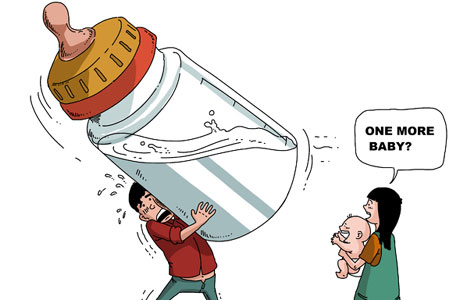
According to a key reform program officially announced Friday, the Communist Party of China (CPC) Central Committee has given the green light to couples wanting to have two children if one of them is an only child, a significant change of the current one-child policy.
Wang Pei'an, deputy director of the National Health and Family Planning Commission (NHFPC), told Xinhua in an exclusive interview that the number of couples covered by the new policy is not very large across the country.
In addition, there is no unified timetable nationwide to start the new policy, as regions will implement it at different times based on their ?local situation, said Wang.
"China's population will not grow substantially in the short term," he added, but suggested that regions which have many suitable couples should promote a reasonable birth interval to avoid birth accumulation. There will also be annual population planning to prevent large fluctuations.
Food security and basic public resource planning are based on the estimated population of 2020 and the peak population in 2033, 1.43 billion and 1.5 billion respectively, Wang said.
The population will not see a strong increase when the new policy takes effect, and in 2020 the population will be significantly less than 1.43 billion, so too the peak population.
"Although newborn population will increase in the next few years, it will be equivalent to that around 2000, so it is safe to say that new birth policy will not be a problem," said Wang.
China in the late 1970s introduced a policy to rein in population growth, with some estimating that it has ?prevented 400 million people being added to China's population, 1.34 billion at present.
The ?birth rate dwindled from 33.4 to 12.1 per thousand from 1970 to 2012, Mao Qun'an, spokesman for the NHFPC, said earlier this week.
Wang said it is not possible to allow all couples to have two children at the present time, as it would lead to high volatility of the infant population, putting too much pressure on public services, while in the long term, will result in continued growth in population and postponement of the peak of population, which will have a negative impact on China's economic and social development.
The adjustment of birth policy does not ease family planning work, said Wang, who added that the basic state policy of family planning will be adhered to over a long period of time.

Copyright 1995 - . All rights reserved. The content (including but not limited to text, photo, multimedia information, etc) published in this site belongs to China Daily Information Co (CDIC). Without written authorization from CDIC, such content shall not be republished or used in any form. Note: Browsers with 1024*768 or higher resolution are suggested for this site.
License for publishing multimedia online 0108263 Registration Number: 20100000002731